Showing posts with label Alice Waters. Show all posts

Friday, February 18, 2011

Alice Water's Cook Book


In the previous post I had to restrain myself from carrying on some more. The tea was cold. My feet were cold, the cat was hungry.

Alice Waters, genius. Why? Because she has a cookbook that I wish I had had when I was new to the kitchen. Her cookbook "The Art of Simple Food" takes the wannabe cook or the 'if I don't cook, i won't eat' cook into the world of "Starting from Scratch...Lessons and Foundation Recipes"

I first found this book at the library and was so impressed (and this is coming from a person who thinks every minutes spent in or near the kitchen is a bad minute) I bought the hard copy.

ISBN 978-0-307-33679-8 Clarkson Potter Publisher, New York, $44.00 Can.

I'm sure there is a link to a book seller but I can't get that to work. I bought it at BookMark on Spring Garden Road. They are terrific and a local bookstore, not a box store.

But why Alice Waters in the first place? Alice opened her restaurant, Chez Panisse,in 1971, in California I think. Her idea was to to serve organic, seasonal dishes, with the menu changing frequently to reflect this. She began to shop at farmers markets for her ingredients. This is how we stumbled onto her, through the local food, local diet movement.

Her principles are:
Eat Locally and Sustainably,
Eat Seasonally,
Shop at Farmers markets,
Plant a garden,
Conserve, compost and recyle,
Cook simply, engaging all your senses,
Cook together,
Eat together,
Remember food is precious.

Those are pretty good principles, don't you think?

To illustrate how great this book is, in the chapter on Broth and Soup, Alice covers how to make Chicken Broth, Carrot Soup and Minestrone. How to bring a broth to a boil and not scorch it, the difference between a light broth and a rustic broth. She shows variations on the carrot soup while the Minestrone soup can evolve into a Fall or Winter or Spring variation. As a new cook, never would this have happened. I would have bought a different can of Campbell's and changed the cheese in the sandwich, thinking I had done something bold.

Along the way Alice explains how to use tools beyond a wooden spoon and a spatula. To give you a clue as to what kind of cook I used to be, I called the spatula "the shovel".

The second part of the cookbook is "At the Table, Recipes for Cooking Every Day". Sauces, Salads, Eggs and Cheese, right on up to Deserts. You learn how to plan, four essential sauces, and it continues; Simmering, Rice, Out of the Frying Pan, Into the Oven, Over the Coals and so on.

In the chapter on Sauces, Alice provides recipes for every sauce you would likely have bumped into; Tartar sauce, Bechamel sauce, bolognese sauce, warm butter sauce, pesto, tomato salsa, peach salsa, creme fraiche, garlic mayo, herb butter, simple tomato sauce.

The thing I love about this cook book is that it doesn't have all kinds of complicated steps, the organization is easy to penetrate, the recipes are simple but unfailingly good, and her instructions are so instructional yet kind.

White sauce (Bechemal Sauce) ...."To avoid lumps, completely whisk in each addition of milk before adding the next. If, despite this, the sauce is lumpy, strain it through a sieve after all the milk has been added and return to the burner to cook. Bring slowly to a boil, stirring all the time. Turn down to a bare simmer (use a flame tamer if necessary) and cook for 20 minutes, stirring occasionally to keep the sauce from sticking."

I would have phoned my mom at the first sight of lumps, (spending vast amounts on long distance calls since everything failed for about 3 years) abandoned ship if whatever my mom said didn't work. Or I would have started reading a book during the 'stirring all the time' part, assuming the recipe writer was an ambitious sod with no life beyond the stove. If I knew why I had to stir for all that time, I might have done it. You notice that it never occurs to me in that stage of life that there is any correlation whatsoever between the not stirring and the scorching. But Alice explains it and in such a nice way too. And because she has such a pleasant way about her writing, I am tempted to read to the end of the recipe instructions.

These days I still read the ingredients list, assume if it's a sauce, it all gets stirred and just wham it all together and wonder what went wrong. Alice goes on to say...'season with salt, a pinch of nutmeg (optional) a pinch of cayenne (optional)' (in my world view anything that says optional means ignore) and then she says 'use right away or keep warm. (the sauce will solidify when cool).' You can see what would happen in my life. I'd make the sauce the day before or in the morning before classes and come home to a solidified sauce, thrown it out, cried, phoned my boyfriend and begged to be taken out to dinner. The boyfriend, who happened to be Steve, would snort and be disagreeable and lecture me on reading all the instructions and then would have come over and fixed it (if I hadn't thrown it out) and then he would have sat reading a book while I struggled with whatever else I didn't know what I was doing, offering uncalled for advice and commentary from the next room.

These days, Steve reads Alice, agrees with her about everything, cooks amazingly, has given up being disagreeable and snorting and lectures only students because I'll sock him if he lectures me one more time. I have had to give up crying to be rescued, must read all instructions (I tend to forget this) and I read at the kitchen table while he cooks. That means I'm on the hook for washing the dishes (and last night Phoebe and I killed ourselves laughing because the white dishes still had lots of white sauce on them after being washed - so my new life lesson is to wear glasses when doing the dishes)

Well that tangent had little to do with Alice, except as you can see, cooking in this house is a whole lot more interesting, and if I have to do the cooking, there is a decent chance it will turn out (depends on lot on how good my fiction book is). I bought this cookbook for both Lucas and Phoebe when they left home and they both cook very well. Friends often phone them up for cooking advice and out comes Alice. I'm not sure if she is given credit or not by the kids, but at that age, would you have?

Alice Waters created the Chez Panisse Foundation, supporting an edible schoolyard in Berkley.

www.chezpanissefoundation.org

Sunday, January 23, 2011

Atlantic Provinces Dark Days - Yam & Corn Chowder or Beef Burgundy

Do these Dark Days Dishes all seem a little dull in colour to you? As a colour addicted nut, I find the dishes a little uninspiring. However, the flavours, Um um good!

(this post is a bit long, is your tea hot?) (the photo is the cottage Steve designed for the Theriault's in Pugwash. That's where we snuck off to last weekend.)

This winter our cooking is as close to 100% local as it will ever get unless someone starts making good local olive oil, parmesan cheese, and coffee. And since that isn't going to happen, we have found Fair Trade alternatives. At Italian Market, we get an olive oil that is made by a family in Italy that has relatives in Ontario and Nova Scotia who act as distributors. Local in its way. We buy our Coffee, tea, sugar, chocolate for eating and baking and sometimes spices from Just Us Coffee on Coburg Street or in Wolfville if we are there.

The cheese? It isn't easy to make cheese. The Dutchman's goudas are pretty good, his Dragon's Breath is the exact right kind of awful. There is another vendor whose name I need to get who does a nice job with goat cheese and feta. But a good cheddar.....gotta get it from PEI, either Avonlea muslin wrapped cheddar or COWS cheddar.

We've realized that we have to add our colour into the food we cook on purpose. The broth or barley or meats are all beige-y, salmon starts out looking pink but cooks down to little slivers and the veggies tend to get a bit weary looking. So what's a chef to do? Red Peppers!
(Red Peppers by artist Sarah Lynch)
Last summer we roasted local red peppers, along with any other coloured peppers we could find, and then froze then up in small snack sized baggies. And they are almost gone. Thank goodness for the tomatoes we froze and dehydrated. They give a bit of colour kick. The dehydrated celery leaves add some green. Pickles add green. But that's all we have. This is something to put our brains to do during next season's preserving adventures.

Last Friday night I had the fun challenge of speaking to the College of Sustainability's Student Society. The topic was "Hungry in Halifax? Learn to eat local away from home" The other guest speaker was George (can't find his last name), owner of the Brooklyn Warehouse. Their menu consists of many fine dishes, with lots of local products. George spoke of the priorities and challenges facing a restaurant while I spoke as a person with an average kitchen. Of course, I have an above average cook in the house. Steve's comments ran along the lines of loving to cook, taking a few base ingredients and adding this and that and finding out what will happen. He also praised the joys of local veggies and fruit. I think both our messages were that you have to love either the process of cooking or the end product of cooking otherwise the whole business of local or not local becomes just tedious in the extreme. I'm not a cook, or a baker, or even really very good at preserving. I love a puzzle. I love to figure out what produce is available when, how much we'll need, what to do with it so we have it over the winter, how to maintain it, in what fashion should we get it out of storage (bake some blueberries, juice some tomatoes) and I love, love, love to eat Steve's cooking. I can only think of 5 meals in more than 30 years of being together that were better than something Steve cooked. They were all high end Italian meals, one of them a friend's mom who cooked an amazing meal with a finger that needed stitches the next day! That's-a love.
(Google images)
Before we share with you the third installment of our Dark Days Challenge, I would like to share with you how to change your kitchen from filled with pre-packaged goods to a kitchen filled with local fare. It begins with breakfast. We tell most people to start making changes with one meal of the day and the easiest one is breakfast. Most people have a small repertoire of food they eat before charging out the door. Cold cereal, toast, hot cereal, fruit or yogurt or nothing. Not too often does someone make a full bore breakfast with eggs, bacon, sausage and hashbrowns. (I can think of one person and his wife is holding the greasy skillet high over his head when he ain't looking.) Because this is a small range of dishes, it is relatively easy to find local alternatives. Speerville Mills has a wide assortment of grains that can be substituted for hot cereal, or turned into homemade bread for toast or buns or granola or energy bars. They have two great pancake mixes. Fruit can be frozen or turned into jams, jellies, preserves or fruit butters. The dehydrator can dry up many fruits that can be added to hot cereal or baked or moistened with yogurt or juice. Yogurt can be bought locally at the market or a yogurt maker could be purchased and possibly shared with other people who don't eat too much yogurt. Jams for toast....make your favourite and trade with others for their favourites and you get variety. Milk, cream, butter, maple syrup, blueberry syrup, sugar, eggs, bacon, sausage, can all be bought locally, some of them even from the superstores. Local apple cider and/or pear cider can replace all citrus juices. There is even blueberry juice for variety. Eggs keep for a long time, so buy two dozen when you go to the market or Local Source on Charles Street. More than one meal of pancakes or french toast can be made ahead and treated like pop-tarts. Ta-dah!
(we needed a photo after that last paragraph. this is the backyard clothesline)

You notice I didn't find a substitute for cold cereal or nothing. I just haven't looked for cold cereal substitute and nothing never crosses my mind. I wake up and head straight for the table to eat.

There you have it. The easiest meal to change to local and it can mostly be done at the superstore or with one pre-planned trip to the market for eggs and possibly cider. The preserving takes a different kind of planning, one I will talk about soon-ish-ly. But it is more in the order of having fun with a few friends or family. Consider preserving an extended outing.

The Atlantic Provinces Dark Days Challenge #3 brings you two offerings. Don't forget to check out Local Kitchen or the Un-Hennery for their great ideas.

Yam and Corn Chowder, with sourdough bread and smeerkaas (cheese). (no photos)

Beef burgundy with mashed garlic potatoes, and leftover mixed green salad and I haven't figured out what yet for desert.

The Yam and Corn Chowder is so simple it's scary. One baggy frozen home made soup stock, two yams cleaned and chopped, (optional some curry paste or sambal (hot pepper paste 1/4 tsp.), one baggy frozen corn (we did our own corn this summer), one loaf homemade sourdough bread, one jar plain Smeerkaas from the Dutchman (and optional, one jar red pepper jelly from Pat's Preserves at the market). Defrost stock and corn. Put stock in saucepan, add chopped yams, optional flavouring, boil till yams are soft. Remove contents of pot to a blender, or use a hand mixer (be careful not to splash yourselves with hot broth), blend to your favourite consistency, return to pot, add corn, cook. Slice bread, spread with smeerkaas, add red pepper jelly, put soup in bowl, eat. -- Colours are a lovely orange, a soft white/yellow and a cheerful red.

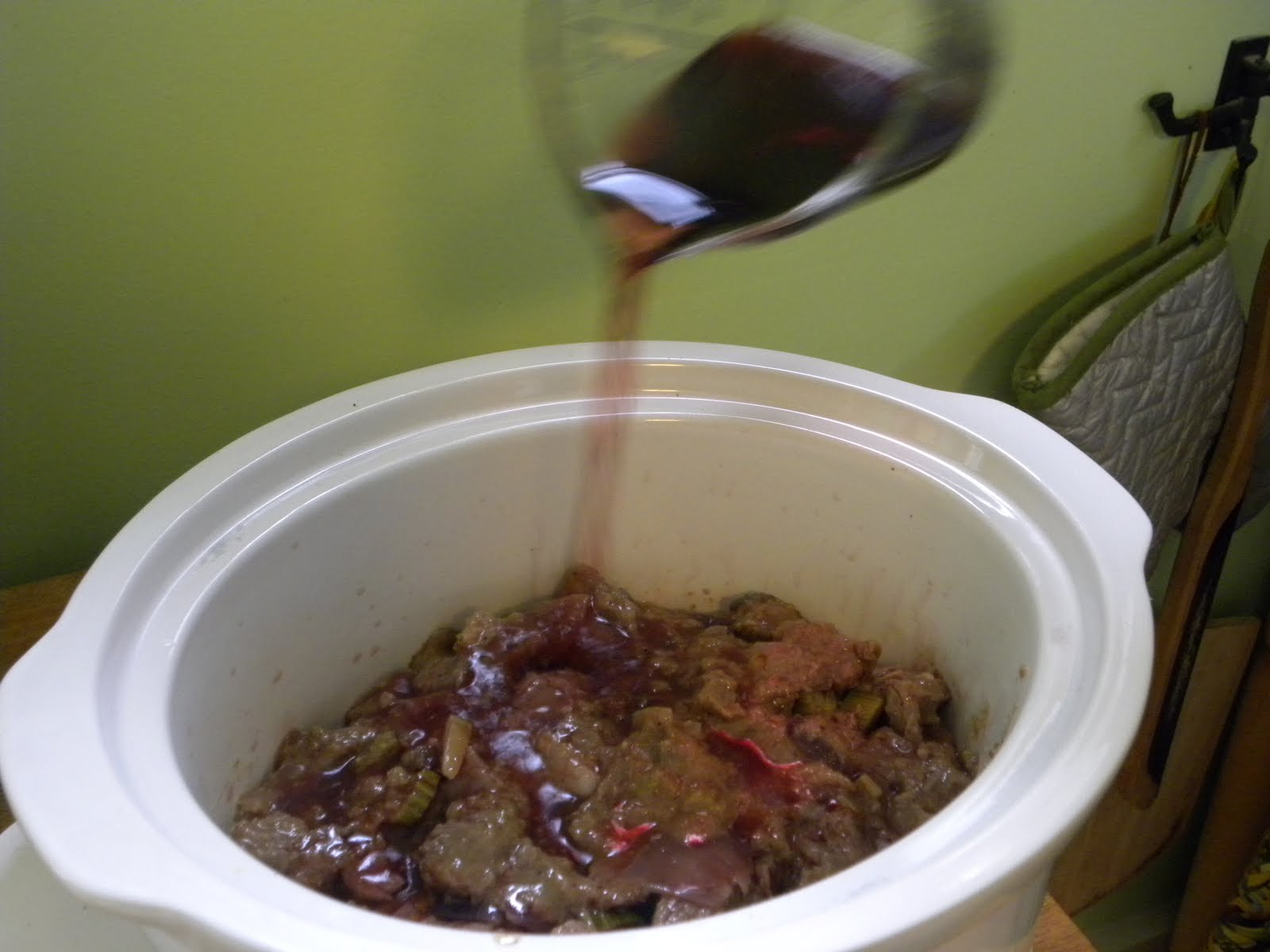
Today Steve made (at 9:30 a.m. Sunday) a Beef Burgundy. It now sits happily in the crock pot and will remain there, ignored by all of us until dinner time. Around 5:30 we'll make mashed potatoes, adding some roasted garlic to them.

Beef Burgundy prep: 30 minutes, cooking: 3-4 hours crockpot on high or 7-9 on low, needs a crock pot or a good stove top stew pot.

Makes 6 servings

2 pounds stew beef cut into chunks
16 ounces of frozen or raw veggies (not soft things like peas)
2/3 cups Burgundy wine or good substitute
1/3 cup water
1/3 cup whole white flour (or 1 TBsp cooking tapioca)

Here's where things got crazy. Steve substituted the 10 ounce can of mushroom soup with 2/3 cups water. Read on for the excitement to continue.

Brown 1 Lb beef cubes in a heavy skillet over medium heat. Do same to second Lb. (so you don't undercook the beef or toss it on the floor. Some people get exercised if they see you picking up the lost beef and adding it back to the floor. The floor is mostly clean) Drain off fat. Or, if you are Steve, you keep the fat, add the onions, brown some more while gradually adding in the flour. When all the flour is in, add 2/3 cup of water. This makes an urky mucky sauce but substitutes nicely for the mushroom soup the recipe called for. Phew, I was tense watching that mad move.

Place cleaned and chopped veggies on the bottom of crock pot. Place beef on top of veggies.
(notice the wizard pj's)

Combine 1/3 cup water with 2/3 cup wine. Pour over beef.

Cover and cook on low for 7-9 hours or high for 3 1/2 to 4 1/2 hours.

To serve, spoon beef mixture over mashed potatoes. Sprinkle with fresh parsley if you have it growing somewhere in the place. Add wine to wine glasses. Toast yourselves.

ps. if it is too watery for your liking, take a ladle or two of veg/beef/broth and blend them in the blender then add back to dish. If it is too thick, add more wine or soup stock if you have it on hand. Another option if it is too thick is a bit of sour cream or yogurt.

-- Colours - browny with bits of orange.

Resources:
Lute music to listen to on a Sunday morning - Michel Cardin "S.L. Weiss, the London Manuscripts, vol. I, from Moncton New Brunswick, (Cardin is from Moncton, Weiss is from some European country and long dead by now)
Yams, onions, parsnips carrots, mushrooms, celery (summer purchase) - Elmridge Farms
Green beans & blueberries - (summer purchases) Bob and the Boys, produce stand near Bridgewater (on our way to our camp)
Smeerkaas - Dutchaman's cheese
Red pepper Jelly - Pat's Preserves
Stew Beef - Getaway Farms
Potatoes - Black Pond Farm (PEI)
whole white flour - Speerville Mills
Mixed Greens, pea shoots - Richter Herb Farm
Better Homes and Garden special interest publication "Slow Cooker Favourites" 2008
(a tremendous resource for recipes is Canadian Living's on line recipe files)
Marechal Foch Red wine - Domaine de Grand Pre winery


Two other local meals for you to research are:
Roast chicken with roast turnip, potatoes, onions and homemade applesauce,
Barley and seafood risotto with mixed greens, pea shoots, feta and dried blueberry salad.

Another great, great, great resource is Alice Waters cookbook "The Art of Simple Food" Alice was one of the promoters of slow food. I think I will write about Alice next but I feel a Hot Flash Woman episode coming on.