Showing posts with label sustainable practices. Show all posts
Showing posts with label sustainable practices. Show all posts
Tuesday, January 21, 2014
Simple Pleasures - Rascal's Delight

Thursday, January 16, 2014
A Week of Voluntary Simplicity - isn't it over yet? Part D
 |
| A fragment of the Natchez Trace Trail, a wagon road for settlers into the interior of the US. |
Is this killing you? If you are still reading this week, then maybe you are secretly trying to figure out for yourself how to go about living a life with some changes. You don't have to find God to make it work, or twist yourself into a pretzel yoga pose to find it either. Here are my suggestions.
 |
| The Ryman Auditorium, the home of the Grand Ole Oprey until the '70s |
Let's pretend that you live in an apartment and there isn't a choice about what sort of toilet you have, so buying a dual flush one won't happen. You have sensitive teeth or dentures. Changing toothpaste isn't really an option especially since all other options are just as non-green or too expensive or taste like hell.
Get up anyway, don't let a lack of ideas hold you back. Get breakfast. Look at what is on the table in front of you. Is there a single food option that you could alter? Can anything on that table be bought locally or through a CSA box or in a fair trade exchange? No? Well, don't worry, move on.
Ask the same questions as you put on your clean underpants, jeans and shoes. Get your coat on and hop onto your form of transportation. Any changes showing up as possible yet? No. Don't worry, keep going.
You're at work, or visiting or volunteering. Do you see anything that can be recycled, could you turn lights off, could newspapers be shared, did you notice anyone you could offer a ride to? I bet you're getting kind of pooped by now. It's almost over.
Lunch - look at it the same way as breakfast.
Your afternoon activities - you get the picture.
You are back at home and all this questioning has given you a headache. Get that glass of wine or beer, you deserve it. You have just accomplished the first major step in Voluntary Simplicity. You have examined your actions towards a deeper understanding of your patterns, your preferences, your community, and also, your tolerance for the whole project.
I suspect that along the day, several glimmers of ideas came your way and they will pop back up. You don't need to chase them down. They will show up again
 |
| Bridge on the Natchez Trace Parkway, Nashville. |
Congratulations, you have made a change and I bet you feel positive about it. Do it again. Keep going but stop before you feel exhausted. Pretty good is good enough for now.
 |
| I ran out of poetic metaphors and images. See what you can make of this. |
Wednesday, January 15, 2014
A Week of Voluntary Simplicity - My attempts - Part C
It doesn't do any good to bring out a book and wave it at people, saying to them "Do Something" without examining my own life.

Voluntary Simplicity for me is a way of thinking as much as a way of living. It means thinking out significant decisions in as deep a way as I can. Recognizing the difference between a need and a want, and also realizing that on occasion, there is room for the things we want. It also has to do with letting go of anger, envy, greed and mindless privilege.
Here are some truths for me:
It is easier to achieve when there aren't children in the house,
it is easier to achieve if there is a single income that has been carefully considered over the years,
it is easier to achieve if there are other people around me who aren't determined about getting somewhere else (raises, jobs, new this or that),
it is easier to do if I don't shop often, don't read magazines, or listen to the news.
It is harder to do if I am tired, sick, lonely or angry,
it is harder to do if I have tied myself into a knot by denying myself something that isn't really that significant.
(For instance, the world won't end if I buy a book instead of borrowing it from the library, in fact, it can be good for the publishing industry)
It is harder to do when I feel I am acting with poor information; if I don't trust the media or the politician or the corporation.
It is harder to do when being simple feels like a political action that rubs my friend's noses.
That doesn't mean I don't attempt it, it's just harder. Sometimes too hard, and I give myself permission to fail and try again later.
What do I do that's simple? The easy stuff, because it's easy. We recycle, reduce, reuse and repair. I know how to do many handcrafts, knitting, sewing, spinning, cooking, preserving, making music, reading, writing and drawing. I can reduce some kinds of shopping, make things, and entertain myself quite easily. I like being with people sometimes, this increases my engagement with community. I volunteer, another way to create community. I work from the home, we reduced the number of extra curricular activities we all did to reduce running around, we take time to assess decisions, we take time to celebrate. Especially my birthday, which requires cake and cards.
What is really tricky is finding reliable information to make decisions with. Banking - our mortgage is with a bank I regret instead of a credit union. Pretty much the same with investments. Politics - I think everyone is lying about something - I have no faith that the political arena is a good arena. But I do believe I have a duty to keep expressing and demanding my civic rights, my environmental rights and political rights. Maybe one day these systems will heal.
 I am terrible at going to rallies or writing politicians. I am good at community building and communicating. It is possible for us each to act in our own political way. And to let go of judging.

Voluntary Simplicity for me is a way of thinking as much as a way of living. It means thinking out significant decisions in as deep a way as I can. Recognizing the difference between a need and a want, and also realizing that on occasion, there is room for the things we want. It also has to do with letting go of anger, envy, greed and mindless privilege.
Here are some truths for me:
It is easier to achieve when there aren't children in the house,
it is easier to achieve if there is a single income that has been carefully considered over the years,
it is easier to achieve if there are other people around me who aren't determined about getting somewhere else (raises, jobs, new this or that),
it is easier to do if I don't shop often, don't read magazines, or listen to the news.
 |
| Here's a metaphor for you. If every item in the woodshed were a decision, and they don't all fit nicely together, and there are a few that don't fit well, and a few that don't fit in at all but nearly do, but they are made with the intention of simple living, then eventually the woodshed holds it all together. |
It is harder to do if I am tired, sick, lonely or angry,
it is harder to do if I have tied myself into a knot by denying myself something that isn't really that significant.
(For instance, the world won't end if I buy a book instead of borrowing it from the library, in fact, it can be good for the publishing industry)
It is harder to do when I feel I am acting with poor information; if I don't trust the media or the politician or the corporation.
It is harder to do when being simple feels like a political action that rubs my friend's noses.
That doesn't mean I don't attempt it, it's just harder. Sometimes too hard, and I give myself permission to fail and try again later.
What do I do that's simple? The easy stuff, because it's easy. We recycle, reduce, reuse and repair. I know how to do many handcrafts, knitting, sewing, spinning, cooking, preserving, making music, reading, writing and drawing. I can reduce some kinds of shopping, make things, and entertain myself quite easily. I like being with people sometimes, this increases my engagement with community. I volunteer, another way to create community. I work from the home, we reduced the number of extra curricular activities we all did to reduce running around, we take time to assess decisions, we take time to celebrate. Especially my birthday, which requires cake and cards.
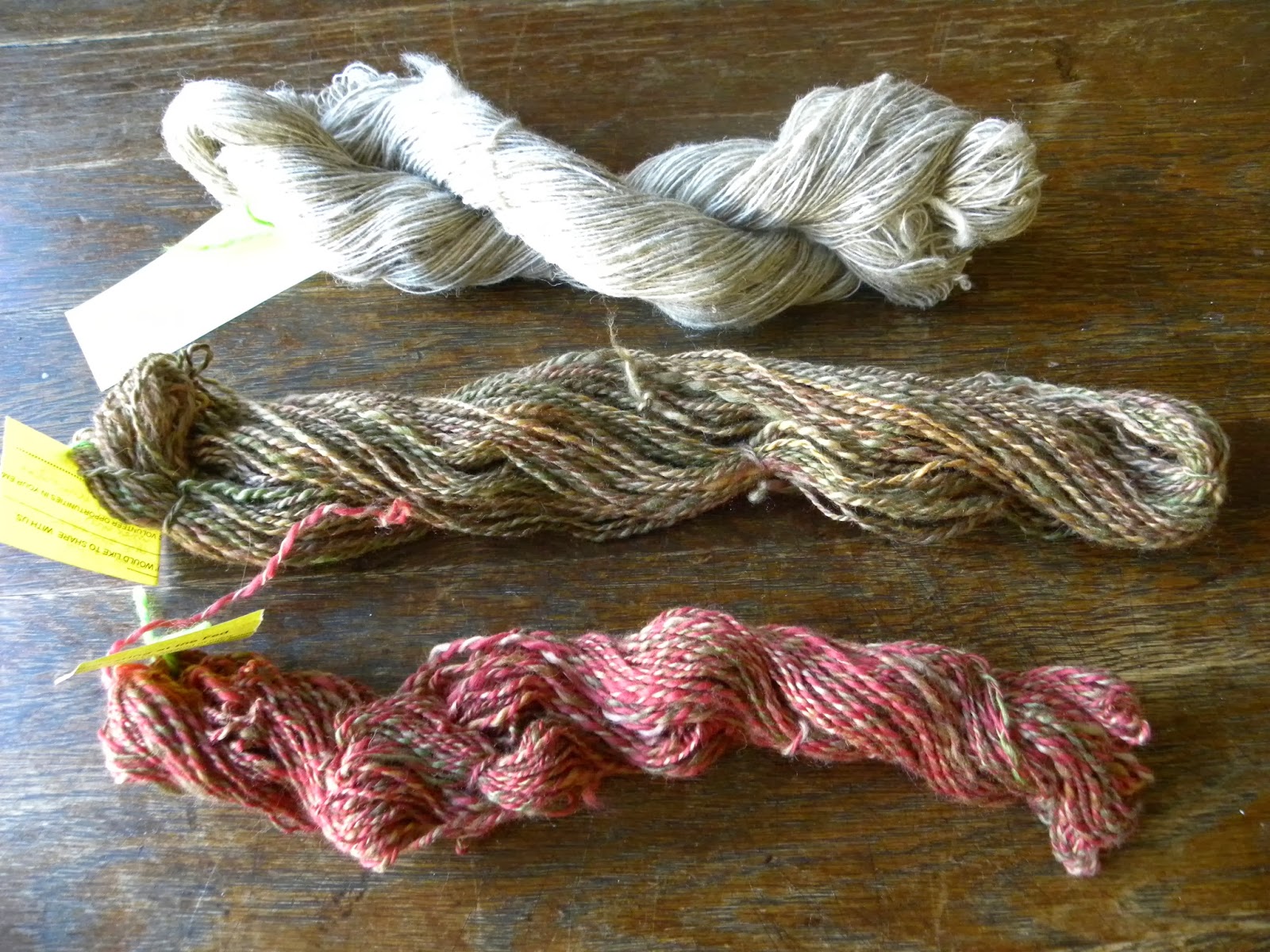 |
| Here's another metaphor. Simplicity looks different for each person. |
What is really tricky is finding reliable information to make decisions with. Banking - our mortgage is with a bank I regret instead of a credit union. Pretty much the same with investments. Politics - I think everyone is lying about something - I have no faith that the political arena is a good arena. But I do believe I have a duty to keep expressing and demanding my civic rights, my environmental rights and political rights. Maybe one day these systems will heal.

Tuesday, January 14, 2014
A Week of Voluntary simplicity - Expresssions, Part B
Duane Elgin in Voluntary Simplicity drew up a list on typical practices of those who self identify as living a simpler life:
-Invest time and energy by simpler living in activities with partner, children, friends (walking, music, meals, camping) or volunteering or civic affairs
-work on personal potentials - exercise; emotional development (relationships); mental skills (reading, classes, new skills); spiritual (quiet mind and compassionate heart (a summary from many faith paths))
- reconnect with Earth, ecology, environment,
-concern for world's poor, social justice, use of world's resources,
-lower levels of personal consumption - buy less, reduce personal ornamentation, fewer cosmetics, holidays made less commercialized,
-consumer goods that are more durable, easy to repair, non-polluting in manufacturing, energy efficient, functional, aesthetic,
-shift diets away from processed foods, meat and sugar, (huge debates on the food topic - too complex to comment on here)
-reduce clutter and complexity in personal lives, (yeah, but don't buy magazines to tell you how and then buy pretty boxes that fade to fix it up)
-use consumption politically,
-recycle, cut back on items that are wasteful of non-renewable resources
-pursue livelihoods that directly contribute to the well-being of the world and uses creative capacities*
I have a problem with this one. I think a better phrasing might be find a lively hood that causes no harm. Lots of scientific discovery has been co-opted by the military or corporations. Many jobs are interesting but require a greater sensitivity to global concerns. Would it be wrong to be a stock broker if markets were more responsible? Bankers and banking policies? I'm all for using creative capacities provided it isn't about being a robber baron.
-prefer smaller-scale, more human sized living and work environments,**
I don't buy this entirely. It's too complex an issue. If you sell your mega home to live more simply, aren't you just off loading your consumption onto someone else and going to the bank with the profit? Also, living and/or working in a dense urban center means less energy consumption over all. In some ways, what is wrong with an office tower? This needs rethinking given current potentials in heating and cooling and public transportation. New York City is probably one of the most environmentally sustainable cities, simply because people and systems are so close together and can reduce gas consumption by a huge degree, if only......
-I like this portion of the list but think the rest is full of self congratulations. Read page 110 and see what you think.
Overall, there needs to be a precaution against two things. Don't congratulate yourself too easily and don't rationalize hard choices too quickly. This needs deep work to figure out choices that are sensible, possible to endure and not a response to guilt. Therefore, resilient.
-Invest time and energy by simpler living in activities with partner, children, friends (walking, music, meals, camping) or volunteering or civic affairs
 |
| Students playing at the Annual No Talent show. They had never played together before, but they sounded great. Steve had his banjo playing debut that night. He's been a nut about it since, and he's happy. I have better headphones now. |
-work on personal potentials - exercise; emotional development (relationships); mental skills (reading, classes, new skills); spiritual (quiet mind and compassionate heart (a summary from many faith paths))
- reconnect with Earth, ecology, environment,
 |
| Walking at Point Pleasant Park in the spring. City parks can be lovely. |
-concern for world's poor, social justice, use of world's resources,
-lower levels of personal consumption - buy less, reduce personal ornamentation, fewer cosmetics, holidays made less commercialized,
-consumer goods that are more durable, easy to repair, non-polluting in manufacturing, energy efficient, functional, aesthetic,
-shift diets away from processed foods, meat and sugar, (huge debates on the food topic - too complex to comment on here)
 |
| Baked apples. Every three months we gathered at a different house with a different theme for the meal. Now we meet for different pizzas and beers. Not as earnest, but we support local pizzerias and local breweries. |
-reduce clutter and complexity in personal lives, (yeah, but don't buy magazines to tell you how and then buy pretty boxes that fade to fix it up)
-use consumption politically,
-recycle, cut back on items that are wasteful of non-renewable resources
-pursue livelihoods that directly contribute to the well-being of the world and uses creative capacities*
I have a problem with this one. I think a better phrasing might be find a lively hood that causes no harm. Lots of scientific discovery has been co-opted by the military or corporations. Many jobs are interesting but require a greater sensitivity to global concerns. Would it be wrong to be a stock broker if markets were more responsible? Bankers and banking policies? I'm all for using creative capacities provided it isn't about being a robber baron.
 |
| Snow the Cat wants to be a Train Conductor but only if he's allowed to nap on the job. |
-prefer smaller-scale, more human sized living and work environments,**
I don't buy this entirely. It's too complex an issue. If you sell your mega home to live more simply, aren't you just off loading your consumption onto someone else and going to the bank with the profit? Also, living and/or working in a dense urban center means less energy consumption over all. In some ways, what is wrong with an office tower? This needs rethinking given current potentials in heating and cooling and public transportation. New York City is probably one of the most environmentally sustainable cities, simply because people and systems are so close together and can reduce gas consumption by a huge degree, if only......
-I like this portion of the list but think the rest is full of self congratulations. Read page 110 and see what you think.
Overall, there needs to be a precaution against two things. Don't congratulate yourself too easily and don't rationalize hard choices too quickly. This needs deep work to figure out choices that are sensible, possible to endure and not a response to guilt. Therefore, resilient.
Monday, January 13, 2014
Voluntary Simplicity - let's look at it. Part A
Richard Gregg paraphrasing a teaching of Mahatma Gandhi (1936)

here

About 5-ish years ago we decided to get local with our food and as many other purchases as we could. It has been an interesting ride. Voluntary Simplicity seemed easy in relation to these two choices. (click here to read other posts, voluntary simplicity, )
But what is Voluntary Simplicity? Voluntary of course means that there is a choice about lifestyle. It means there is a conscious attempt to make a change. Simplicity is a testimony for Quakers and other groups. There are a gazillion responses to this query. I think what it boils down to is to live below your means, to be involved with local community, to be aware, to give, to avoid waste in as many ways as possible, to be resilient.

Elgin participated in the "Voluntary Simplicity Survey" I don't know about it's statistical validity. It seems sound, but then who knows with statistics. What is interesting is that voluntary simplicity is rarely a path chosen by those who began life in poverty, who are from a non-white background,or have slightly lower than middle incomes. It also shows that this path is across geographies, largely urban, involves people with higher education (it doesn't state where higher begins), and most people had been engaged for 6 or more years. It doesn't seem to be a fad, also given the book is 32 years old. I wonder what the survey results would look like now?
Lately, it also means to discern if you are being tricked into thinking you are buying a simple/sustainable option. Carbon offsetting is a game. Dual engines are a scam. Simple living style magazines are a definite pander. Don't get me started on organic cotton or bamboo fibres. Look at it! What processes are going into things. (ooops, bit of rant that last bit)

In preparing this blog, I found it interesting that my most careful photographs came from my textile work or from trips to the country side. I have read a completely different book about Nature in urban settings. I smell a challenge to find pattern and serenity inside city limits.
I'll look at "Common Expressions of Simpler Ways of Living" by Elgin next post.

Monday, November 25, 2013
Laughing in the Studio
Studio work is rather laughable at the moment. But writing zooms along.

I've been reading this book,
Time to Eat the Dog? the real guide to Sustainable Living by Robert and Brenda Vale
http://www.amazon.ca/s/ref=nb_sb_noss?url=search-alias%3Daps&field-keywords=time+to+eat+theh+dog%3F

What I like about it is it gives a scientific (argue as you like about that concept these days) overview on different carbon footprints. Here's a quote to give you an idea.
"It's not what you do, it's how you do it. We cannot do much about embodied energy, except to chose a small car and make it last a long time. We can, however, do quite a lot about fuel consumption." There is a comparator chart, Smart car vs. Toyota Landcruiser with different kinds of fuel consumption. It comes out the way you'd expect it would, the Landcruiser sucks. We've all been listening to car/fuel issues since the '60's or more.
The same goes for food, if you've been paying attention. Building methods are beginning to break into people's consciousness and a small number of people are thinking about stuff. Having too much of it, but a lot of these folks throw out or donate stuff, then trot out (or drive) to buy items that get the organic or local or living simply gold star. Bit of a goof up, that.
What is new to me, well not new, but confirmed, is the chapter on clothes, shoes, spare time, weddings, funerals, laundry and other household matters. All this is a long way of saying that it is more economic, money and carbon wise, for me to make pillowcases myself than to buy them already made. I save close to 30% in both areas.

Saving 30% on anything is worth considering if making it myself is a good idea. I have apron and pajama patterns all ready to tackle this week. Hopefully.

Time to blather on about a few other things. Videos. The bloody things. Two weeks ago I spent most of two days video-ing studio work and not a single one would upload to this site. I haven't spoken to the genius son about this, rather, I've just sulked about it. I will have to sort out the technical bugs before I try that again.
Writing has been going mostly well. Do you ever have that moment when you know you are learning something really important but you'd like to just strangle the teacher or the situation. The last 10 days or so, I've been having a pedagogical experience slamming me in the head nearly every day on the topic of plot. I had several tasks to do on plot. I could see the purpose before the task was completely outlined. The tasks were even things I had the kids do when we homeschooled. I was annoyed at myself for having to re-learn the whole thing again. But I followed instructions, I complied (not easy) and I have found the plot again. I can unroll from the fetal position.
This weekend past we had a "write your pants off" event. We had the weekend to find 24 hours and write like mad, on something already existing or something completely new. I chose something new and managed to write for a whole 6 hours straight. 22 pages of story. Then I needed a hot bath to unkink. We then attached our documents to some thingy that belongs to Humber College students and the others can read what has been written. We are then supposed to comment on each other's work. It sounds simple, but technically it's a killer. Any physically. I hope I get decent feedback.
It is -11 outside, that's with windchill. This morning was my first shift at the Out of the Cold Shelter. I was surprised to find only 7 guest using the beds. Good in that it means less work for me and hopefully people have other shelter, bad in that it is still needed. wouldn't it be terrific if the beds were all empty because everyone had safe, dignified housing
Monday, October 28, 2013
Photos and links

Some days, whatever thoughts I have just won't come out of the brain. They're in there, floating around sipping fizzy drinks and saying na-na-nana-na. Well, I'm going to win this battle with my brain by posting some studio images and giving you a couple of links to entertain you.
Above is a piece I started almost 10 years ago. I used to take a cross stitch along with me on summer holidays. It has been about 10 years since we've had a summer holiday that didn't involve camping. Cross stitch by camp light, falling needles in pine duff and little drips of hot chocolate are not a good combination. It languished. It still languishes, but now in the light of day.

This piece has been wandering around my table for a few months now. It would always come up to annoy me while I was working on Rachia's birthday piece. It is nearing the state of finished. I'm working on the outside edges while I try to find the elusive acrylic rods that I use as a mounting device.


The linen shirt I bought at a Frenchy's, now completely embroidered where ever there was a rust stain. Sort of chiq hippy.


The Links:
I have been watching these several blogs for a few weeks or more and think they are worthwhile if you like gardening, food, thinking or are interested in a few personal challenges.
http://chiotsrun.com
Chiots Run has several features. There is a pod cast about their garden, frugal living, social consciousness at a personal level, easy cooking and a few other bits and bobs. I have listened to a few of their podcasts. Can't say that I am stunned by them, but they do contain some good tips on many things. I learned about cover crops at a small garden level, and about two books that might make a good winter read. I should write a sticky note to myself to review those books here.
http://thehorticulturalchannel.info/
I get a real kick out of this spot. There are several You Tube programs. You can subscribe so that whenever there is a new program posted, you will be notified by email. I like Sean's Allotment. He is a knowledgeable gardener but a hacker. Like me. Sometimes he gets around to weeding, sometimes he doesn't. He reads the packages and leaves them lying around. For the neaty kind of gardener, he'll drive you nuts. But what can be fun is listening to him and imagining cleaning up his allotment garden without having to actually do it.
Titly's Busy Garden is another program. She is a laugh. She is an unreconstructed gardener. If something will destroy the planet but kill the slugs, she uses it. "Talk to the Titli Hand" she says. She can wax philosophical at times.
There are a couple of other programs, but these are my favourites.
http://www.rootsimple.com/
Root Simple is a blog I've been reading for a year or more. It is written by a husband and wife team, he about the garden and technology, she about the garden, bees, food and books. It is a nice balance. Don't go there is you feel challenged by other people's life styles. They promote things like cities with bike lanes and water harvesting. I find myself at this site longer than all others because he often provides links that lead to links that lead to......
And that's it! I hope to get these three links up on the side bar. In the meantime, have a browse and don't forget to visit Hot Flash Woman. She has just met a new and exciting character, Picnic Girl.
Monday, September 30, 2013
Sore Throats? Left over bread?
It's that time of year. Scratchy throats, sore chests, cold heads. And too many left over ends of bread that don't seem to have a purpose. Abra ca dabra.
I found this lemon soother recipe over on Local Kitchen (see side bar) who had found it on Twenty-Two Pleasant.
http://twentytwopleasant.blogspot.ca
It is not measurement specific.
 Slice two or three lemons (after washing skin) thinly. Don't fuss about seeds.
 Shove into one or two or three jars.
 Cover with honey. Let the honey sink. Shake. Cover with more honey.
Repeat until lemons are fully covered with the honey/lemon juice combo. This might take a day, depending on how thick the honey is.
Cover with honey. Let the honey sink. Shake. Cover with more honey.
Repeat until lemons are fully covered with the honey/lemon juice combo. This might take a day, depending on how thick the honey is.
Ideally, let it sit for a week. Phoebe and Steve both came down with sore throats and colds. They dove into a jar the same day I made it. They brewed endless cups of lemon tea and loved it. Very soothing. They both added Rooibos tea to the lemon to make a heartier cuppa. Apparently, this lemon honey will do amazing things:
*keep in the fridge for weeks,
*can be added to by either slicing and adding more lemons, or adding more honey. An eternal jar kind of thing.
*co-join with your favourite alcholic beverage for an amazing toddy.
*do incredible soothing strokes to your ego for being home-made, synthetic free and wholesome.
*replaces throat lozengers if you make a tea, let it cool and take it with you to sip as you feel crummy during the day.
 TA DAH !
Magic trick number two, Bread crumbs.
OK, for you old kitchen duffers, this should (!) be an old trick. But for the newbies, this is a real money saver. Bread crumbs? you say. How can a jar of bread crumbs save me money? The answer is because it replaces expensive pre-packaged options.
Shake and bake - never used it. Panko-smanko. Hamberger Helper - please. (what puncutation indicates scorn).
Here's how she goes:
Abra ca dabra too
 Collect assorted bread ends. Different kinds of breads make for more interesting crumbs.
 Then you put the stale bread crumbs in the grinder upper. This style is best, a blender can work but needs to be fed a handful at a time, or it will clog up.
 Pulverize the buggers.
 Add to an airtight jar. That little gizmo can be bought in the canning section of Canadian Tire or maybe a grocery store. I love it. It gets used for any kind of jar work. Saves a ton of mess.
 Close the lid, put on shelf where you will see it. Add it to ground meat to soak up juices, (meatloaf, meatballs) add spices and use as a topping to give crunch to mac and cheese, tuna casserole, baked pastas with grated Parmesan and so forth. Also makes a nummy coating for fish, chicken, porkchops and other meats I refuse to eat. How do I know it's nummy if I don't eat breadcrumb covered meat. My kids tell me so.
What if you don't have a grinder upper. There is a smaller, one or two cup version for sale that is worth considering buying. Over the course of the year, this appliance is pulled out over and over again and is a major piece in using the food we freeze and preserve. If I had to give up an appliance to save on electricity, it wouldn't be this one. Or the washing machine.
No money? Then consider a rolling pin. Take a tea towel, a sheet of wax paper, bread crumbs, a sheet of was paper and a second tea towel. Roll away. You won't get a fine crumb but a nice 'rustic' crumb. It won't work for coating meat but the other ideas will still be fine.
Ta Dad Too
A final bread crumb tip. Take the torn bits of bread, get a large zip lock baggie, put bread bits in it, toss in freezer. Keep adding until baggie is full. You now have the makings for croutons or a great bread pudding, especially if you added some raisin bread or sweety breads (like ends of banana bread)
So, if you followed my advice about roasting red peppers and freezing celery, buying real Parmesan, you will have a good kitchen structure to take you through the winter. See you at the farmers market.
I found this lemon soother recipe over on Local Kitchen (see side bar) who had found it on Twenty-Two Pleasant.
http://twentytwopleasant.blogspot.ca
It is not measurement specific.


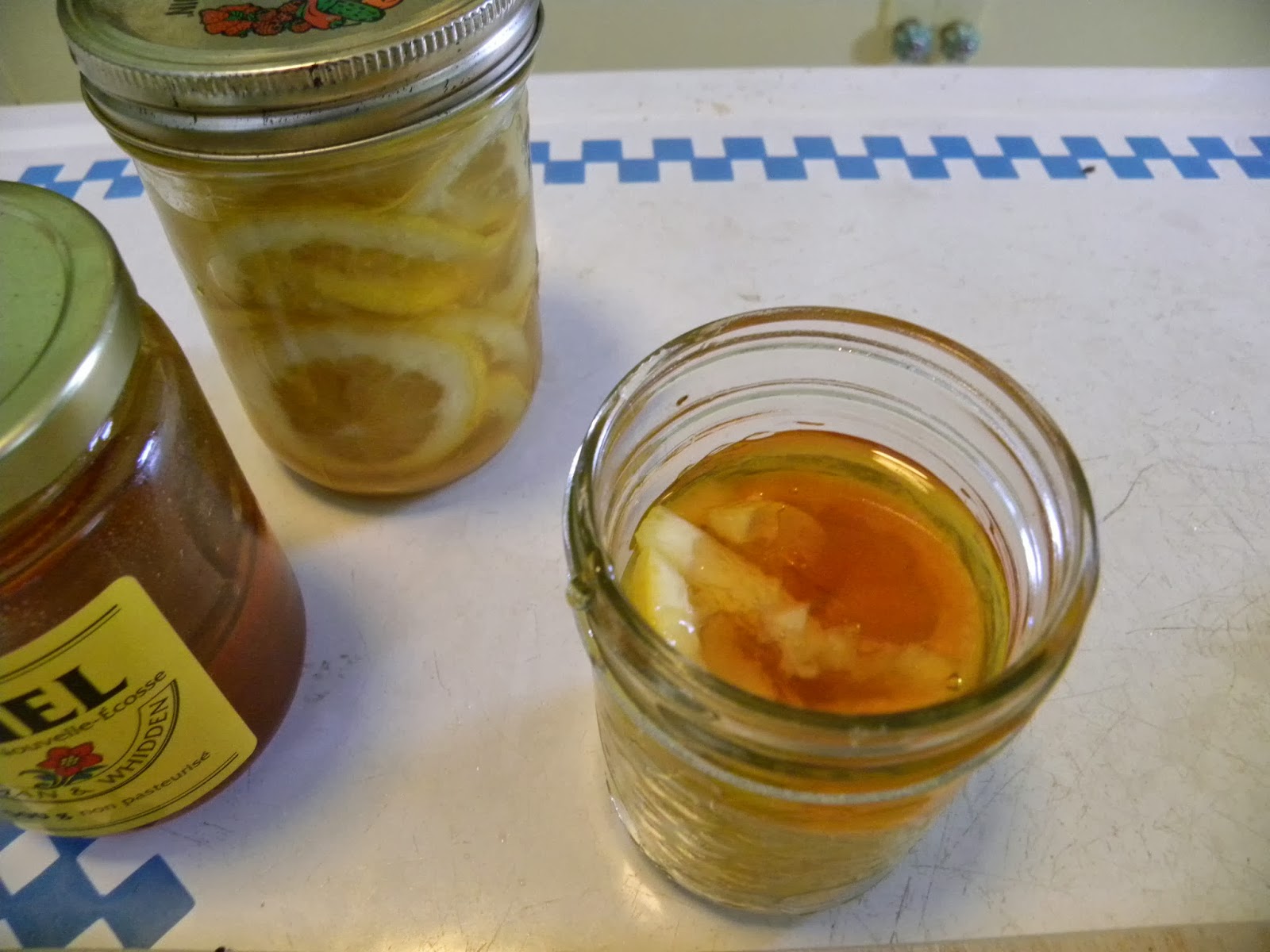
Ideally, let it sit for a week. Phoebe and Steve both came down with sore throats and colds. They dove into a jar the same day I made it. They brewed endless cups of lemon tea and loved it. Very soothing. They both added Rooibos tea to the lemon to make a heartier cuppa. Apparently, this lemon honey will do amazing things:
*keep in the fridge for weeks,
*can be added to by either slicing and adding more lemons, or adding more honey. An eternal jar kind of thing.
*co-join with your favourite alcholic beverage for an amazing toddy.
*do incredible soothing strokes to your ego for being home-made, synthetic free and wholesome.
*replaces throat lozengers if you make a tea, let it cool and take it with you to sip as you feel crummy during the day.

Magic trick number two, Bread crumbs.
OK, for you old kitchen duffers, this should (!) be an old trick. But for the newbies, this is a real money saver. Bread crumbs? you say. How can a jar of bread crumbs save me money? The answer is because it replaces expensive pre-packaged options.
Shake and bake - never used it. Panko-smanko. Hamberger Helper - please. (what puncutation indicates scorn).
Here's how she goes:
Abra ca dabra too


What if you don't have a grinder upper. There is a smaller, one or two cup version for sale that is worth considering buying. Over the course of the year, this appliance is pulled out over and over again and is a major piece in using the food we freeze and preserve. If I had to give up an appliance to save on electricity, it wouldn't be this one. Or the washing machine.
No money? Then consider a rolling pin. Take a tea towel, a sheet of wax paper, bread crumbs, a sheet of was paper and a second tea towel. Roll away. You won't get a fine crumb but a nice 'rustic' crumb. It won't work for coating meat but the other ideas will still be fine.
Ta Dad Too
A final bread crumb tip. Take the torn bits of bread, get a large zip lock baggie, put bread bits in it, toss in freezer. Keep adding until baggie is full. You now have the makings for croutons or a great bread pudding, especially if you added some raisin bread or sweety breads (like ends of banana bread)
So, if you followed my advice about roasting red peppers and freezing celery, buying real Parmesan, you will have a good kitchen structure to take you through the winter. See you at the farmers market.
Monday, September 23, 2013
Video of Bees
But first,
 The table Phoebe fixed. Doesn't it glow?
 I just love walking past it now. No one is allowed to eat on it unless the entire thing is wrapped in three layers of saran wrap. Any one spills something and they have to RUSH to fix it. Some people get new cars, I get a newly fixed table after 30 years of looking at the old scratches. THANK YOU Phoebe!
Now for the Bee video. Nothing to worry about for the squeamish.
The slight noise you hear is indeed the bees buzzing. There is a bit of wind in the background. The little round hole above the main entrance is a second entrance. It is screened over to protect the hive from predators. The hive is still young enough that fighting predators is a challenge. The taped bit at the bottom is also to prevent predators and I think it has something to do with mite prevention as well. I tried to video the way these guys (gals) land but unless you see the flight path coming in from over the garage roof, you can't appreciate how fast they are landing. It's amazing there aren't all kinds of splat bodies on the side of the hive.
This is still a young colony, able to produce honey only for itself. It might stay with me next summer or move to a permanent location. Only the summer can tell. However, no honey sales will happen from my yard, or else I break a by-law or two.
Rachia had her birthday this weekend, so I can post her gift next Monday. And the 2 cords of wood we've been moving for four days. See you then


Now for the Bee video. Nothing to worry about for the squeamish.
This is still a young colony, able to produce honey only for itself. It might stay with me next summer or move to a permanent location. Only the summer can tell. However, no honey sales will happen from my yard, or else I break a by-law or two.
Rachia had her birthday this weekend, so I can post her gift next Monday. And the 2 cords of wood we've been moving for four days. See you then
Monday, July 15, 2013
Urban Farming - July 2013

Before thinking this could work, we had already established organic garden beds, herbs, grapes, pollinating plants, open water for insects and birds. We used the clothesline, inside and out, installed a wood stove, use passive solar heat in winter, reduced water consumption and a few other odds and ends.
I had farm envy. I wanted horse manure to muck about, I wanted chickens to eat the bugs out of my veggie garden, I wanted to not have to listen to my neighbours playing loud, ridiculous radio stations. I discovered I was never going to get the small farm of my dreams and I had to readjust.
I moved along to frustration. How was I going to turn a determinedly north facing garden into a veggie patch? Chickens are outlawed in Halifax. Cows for sure weren't going to work. Miniature farm animals? No go. Everything I thought belonged on a farm, was roadblocked by being in the city.
Then I discovered two major things. One was the "100 mile diet" which I speak about here. The other was the idea that homesteading is about switching my thinking from a consumer's to a producer's. Along the way, I realized there were many things we can do as homeowners that can make time on the earth a little less aggressive.
As you have read, we have switched our eating habits to eating nearly 100% locally produced foods. (Except there is a heat wave on and I am eating Mrs. Vickie's Chips and Sussex Gingerale, so I fib a little bit.) If it can't be locally grown, such as peanut butter, is there a local producer? If it can't be locally produced, such as coffee, can it be "Fair Trade"? If it can't meet any of these criteria, how important is it? So I do without bananas. I do without citrus fruit most of the year. I need an orange in January. It sparks me up to get through to March
As I look through the cupboards, I realize we really have shifted so much that it is hard to find anything that offends.
The Farming Goals haven't been so successful. Our garden is covered in shade. At best we get 5 hours of sun beside a maple that is so shallow rooted, nothing grows under it. It is a perfect place for overwintering the compost and storing a boat.
Livestock is impossible. Chickens, Ducks, Rabbits, Pigeons, Quail and Bees. All not allowed. I was feeling embarrassed at calling myself an Urban Farmer. How is that possible without a crop or an animal?

But good things began to happen. I realized that our garden is the only one in shouting distance with open water in the winter. The photo above is our small fountain. Usually the rocks are wet and there is easy access for small birds and insects. The photo below is our bird bath with electric warming feature.

I still felt embarrassed to mention my notions about Urban Farming. I came across this book again,
http://www.rootsimple.com/2010/06/the-urban-homestead/
The Urban Homestead by Kelly Coyne and Erik Knutzen. They have a great blog coming out of California that I enjoy weekly.
http://www.rootsimple.com/
I read this about 6 years ago, when
dreams of owning a real farm fell flat. I read it again 3 years ago, and put some more suggestions into action. I read it again this spring and realized that while I might not be doing the usual routine of producing my own food and flesh, I am providing a highly essential ecosystem for pollinators. Those butterflies, bees and wasps are all needed to pollinate other people's vegetable gardens. These insects travel for long distances, getting their pollen fix.

Just recently, we became foster parents to a fledgling bee hive. I love them. They are fun to watch, they mind their own business beautifully and I am learning interesting things. They will stay here until they are strong enough to go to a permanent home. I might get a jar of honey out of it, if they do well. Come on Bees.
Monday, July 8, 2013
Rolling Pin Project continues
 |
| Johnson Blue Perrenniel geranium (left front), red dianthus (left back), blue flower, I forget (left back-most), Stella D'ora daylilly (right front), Lady's Mantle (right back) |
I've been taking the leaves and petals off plants in the garden, tossing them onto cloth and then rolling the hell out of them. Completely different work ethic (barely there), completely different colour results (there's colour instead of shades of brown) and completely different plant matter (twig/leaf vs flower/leaf)
What follows is a short photo essay on how I did things. I used a very hot, dry iron to set the colour when I was done. No washing at all. I haven't put anything in a window to test for colour fastness yet.
 |
| Dianthus petals and chopped stems, Mollis leaves. Lay on one half of textile. |
 |
| Textile folded in half and rollered. The big purple blobs are from iris leaves done in the spring with the same method. |

 |
| Neither the Dianthus petals nor the Mollis Leaves did anything noteworthy. Onwards. |
 |
| Johnson's Blue Geranium petals. |
 |
| Mirror images happen by laying the half of the textile without floral matter on top of the textile that does. It doesn't always come out this neatly, because things squish around a bit. If a mirror image is not what you are seeking, then lay the top half textile at an angle to the bottom layer. |
 |
| Mollis before rolling pin. |
 |
| Textile after rolling the Mollis. |
 |
| Geraniums, Dianthus and stems. |
 |
| After smooshing. |
 |
| Day Lilly petals, torn. |
 |
| Mollis added partly through Day Lilly layering. |
 |
| Day Lilly and Mollis. You can see from the (your) right side, that I folded the cloth on an angle, so as to avoid a mirror image. |
This is my usual random, haphazard approach. Someone with more patience could try for pattern repeats or compositions. I dropped and rolled. Sort of the way they tell kids to "Stop, Drop, and Roll" when you are on fire.
Subscribe to:
Posts (Atom)