Showing posts with label freezers. Show all posts

Monday, September 30, 2013

Sore Throats? Left over bread?

It's that time of year. Scratchy throats, sore chests, cold heads. And too many left over ends of bread that don't seem to have a purpose. Abra ca dabra.

I found this lemon soother recipe over on Local Kitchen (see side bar) who had found it on Twenty-Two Pleasant.

http://twentytwopleasant.blogspot.ca

It is not measurement specific.

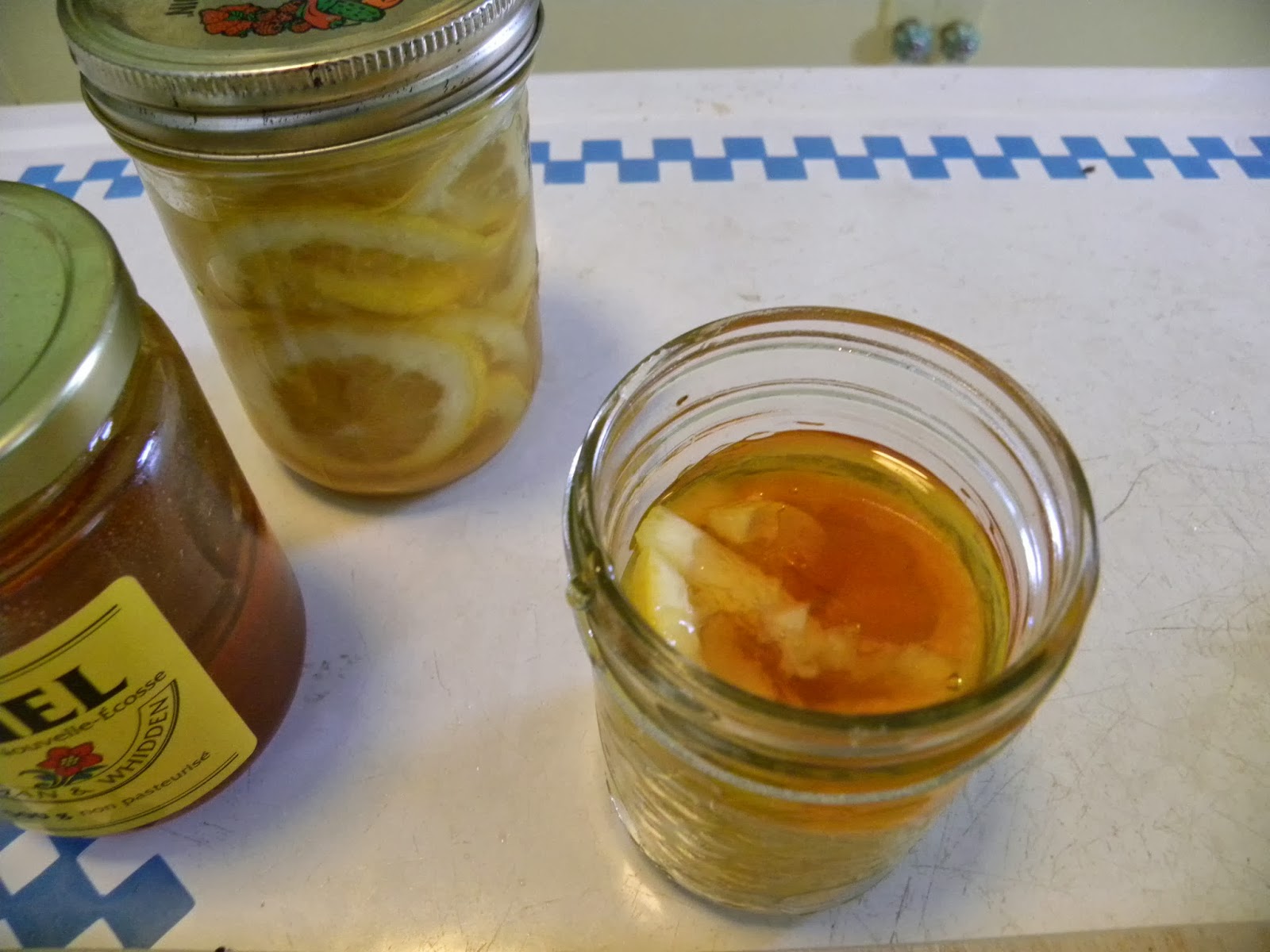
 Slice two or three lemons (after washing skin) thinly. Don't fuss about seeds. 

Shove into one or two or three jars. 

Cover with honey. Let the honey sink. Shake. Cover with more honey. Repeat until lemons are fully covered with the honey/lemon juice combo. This might take a day, depending on how thick the honey is.

Ideally, let it sit for a week. Phoebe and Steve both came down with sore throats and colds. They dove into a jar the same day I made it. They brewed endless cups of lemon tea and loved it. Very soothing. They both added Rooibos tea to the lemon to make a heartier cuppa. Apparently, this lemon honey will do amazing things:
*keep in the fridge for weeks,
*can be added to by either slicing and adding more lemons, or adding more honey. An eternal jar kind of thing.
*co-join with your favourite alcholic beverage for an amazing toddy.
*do incredible soothing strokes to your ego for being home-made, synthetic free and wholesome.
*replaces throat lozengers if you make a tea, let it cool and take it with you to sip as you feel crummy during the day.

TA DAH !

Magic trick number two, Bread crumbs.

OK, for you old kitchen duffers, this should (!) be an old trick. But for the newbies, this is a real money saver. Bread crumbs? you say. How can a jar of bread crumbs save me money? The answer is because it replaces expensive pre-packaged options.

Shake and bake - never used it. Panko-smanko. Hamberger Helper - please. (what puncutation indicates scorn).

Here's how she goes:
Abra ca dabra too

Collect assorted bread ends. Different kinds of breads make for more interesting crumbs.

Then you put the stale bread crumbs in the grinder upper. This style is best, a blender can work but needs to be fed a handful at a time, or it will clog up.

 Pulverize the buggers.

Add to an airtight jar. That little gizmo can be bought in the canning section of Canadian Tire or maybe a grocery store. I love it. It gets used for any kind of jar work. Saves a ton of mess.

Close the lid, put on shelf where you will see it. Add it to ground meat to soak up juices, (meatloaf, meatballs) add spices and use as a topping to give crunch to mac and cheese, tuna casserole, baked pastas with grated Parmesan and so forth. Also makes a nummy coating for fish, chicken, porkchops and other meats I refuse to eat. How do I know it's nummy if I don't eat breadcrumb covered meat. My kids tell me so.

What if you don't have a grinder upper. There is a smaller, one or two cup version for sale that is worth considering buying. Over the course of the year, this appliance is pulled out over and over again and is a major piece in using the food we freeze and preserve.  If I had to give up an appliance to save on electricity, it wouldn't be this one. Or the washing machine.

No money? Then consider a rolling pin. Take a tea towel, a sheet of wax paper, bread crumbs, a sheet of was paper and a second tea towel. Roll away. You won't get a fine crumb but a nice 'rustic' crumb. It won't work for coating meat but the other ideas will still be fine.

Ta Dad Too

A final bread crumb tip. Take the torn bits of bread, get a large zip lock baggie, put bread bits in it, toss in freezer. Keep adding until baggie is full. You now have the makings for croutons or a great bread pudding, especially if you added some raisin bread or sweety breads (like ends of banana bread)

So, if you followed my advice about roasting red peppers and freezing celery, buying real Parmesan, you will have a good kitchen structure to take you through the winter. See you at the farmers market.

Tuesday, September 18, 2012

Local Food and Winter Blahs


There are other colours for winter foods besides brown. If you are trying to go local or organic, this winter preparation will help to make your cooking more interesting. All it takes is about 2 hours on a weekend afternoon, 3 veggies and one box of snack sized zip lock baggies, one cookie sheet, a broiler or a bbq. If you want to go extreme, add in one fruit and one very large zip lock baggy.

Here's how:
Clean out your freezer of junk and knock off the ice build up.
Buy 1 box of snack sized baggies. Find one or two large sized baggy or 3 of the plastic bags that veggies go into at the grocery store.

Buy (from the Farmer's Market at Seaport on Saturdays, or the Farmer's Market at the VG Hospital on Fridays):

one bunch of celery
10 red peppers or a selection of different coloured peppers, not green (because green makes you burp).
10 small eggplants
4 pints of blueberries

Wash all of the above and do the following:
Celery - make sure there isn't any dirt in the lower regions or the leaves. Cut the root off. Cut the entire plant up into 3-4 inch bits. Yes, the leaves also. Toss it around a bit so there is an even distribution of leaves and stems. Stuff into baggies, squeeze out air, place on a cookie sheet or a shallow cardboard box. Wait.

Red peppers - core out the seeds. Cutting into strips is optional. Toss with olive oil or any other cooking oil, but sesame oil might be weird. Roast on a BBQ or under a broiler until pepper has lost its shape. This usually means the skin will burn. Allow to cool. Using a rounded spoon, scrape off the burnt skin. Stuff into baggies, remove excess air and place onto cookie sheet and Wait.

Eggplants - cut into quarters. Toss with olive oil or another oil. Sesame oil might be interesting for these. Roast on the BBQ or under a broiler with the red peppers. They are done when they are completely soft. They may take a bit longer than the peppers. Using a sharp knife, peel off the burnt skin, if you don't like it, otherwise, leave it on. Once cool, stuff into baggies, remove excess air and move onto step 2.

Blueberries - wash all the blueberries, remove any stems or bugs, place onto a large tea towel and sort of gather up the tea towel into a bowl shape. Shake the bowl shaped towel so the berries dry. Place all the berries into the large baggy or the several thinner bags. Place at the front of your freezer so you see it every time you open the door.

Step 2 for veggies:
All the baggies except the blueberries have been place on the same cookie sheet, No? If not, then do so. Place the cookie sheet in a level position in the freezer. Let freeze for 10 hours.

Step 3 for veggies:
If you are an organized person, remove the frozen baggies from the cookie sheet, return cookie sheet to its home. Place the 3 frozen veggies into the door of the freezer. Make a sign to remind you they are in the freezer. If not, just make the sign and tell someone where the cookie sheet is this winter.

How to use your fruit and veggies when the winter is looking pretty bleak for local food stuffs.

Celery - use in making homemade soups, chop into chili or spaghetti or bean soups, add to casseroles, and you have a few spots of green in another wise dull looking dish.

Red Peppers - add to anything that is looking forlorn. Add to pizzas, foccaio, hummus, bean soup or salad, eggs, chicken sauces, fish sauces. Whatever, it adds a nice red to everything.

Eggplants - really, these are brown, but they are a good protein source and can be added as is, or pureed to pizzas, eggs, pasta sauces, into meatloaf. They just extend the flavours of winter a little bit. Some people think they are tasteless, but I think they add a dark, roasted flavour to food.


Blueberries - chip off a 1/4 to 1/2 cup at a time and add them to muffins, plain cakes, coffee cakes, oatmeal cookies, oatmeal, pancakes, french toast, yogurt, applesauce, smoothies, drinks, martinis, and you have a nice blue juice. No long distance fruit for you!

Saturday, October 9, 2010

Harvesting through the freezer

I am very protective of our freezer. We bought this johnny nearly 18 years ago.

It is a front door opening kind of unit, not quite half the height of a fridge. It probably has a quantity like 3 cubic feet or something but I haven't any idea anymore. I paid $50.00 for it from a young couple who were taking their two babies and driving out west to start a new life.

Some years our freezer has stayed unplugged especially when the kids were little and it took all my energy to just deal with right now, let alone next month. During Hurricane Juan, I was in a total state of panic, we had just put in all kinds of frozen blueberries and would lose them if the electricity didn't turn on soon. We shoved in ice packs and ice bags and wrapped it up and 8 days later when the lights came back on, we still had frozen blueberries.

I would not have done that with meat, just in case you think I'm completely bonkers.

As we have been challenging ourselves with the hundred mile diet (more on that in the future) we have been learning to use our freezer most creatively. We don't freeze any meat in that unit, we put in broccoli, cauliflower, blueberries, green and yellow beans, rhubarb, asparagus and in the late winter we stock pile some cider for Steve's drinking in the summer. We also put our soup stock, chilies and spaghetti sauces in there.

This summer we expanded our freezer contents to include corn and we have concluded that last winter's experiment with tomatoes was a great success. This summer we put in a pint of peaches to see if the skin will peel off as easily as the tomato skins do and what the texture and flavour will be like.

Where the freezer really makes it's presence felt daily is upstairs. We have the usual fridge size freezer and in the door, in little wooden pint boxes we have frozen parsley, dill, basil, sage, marjoram, onion greens, roasted red peppers, roasted egg plant and celery.

I written about the celery on an earlier blog. The remainder of the frozen herbs make the winter local food restrictions more than bearable. It makes the root vegetables and the frozen products from downstairs simply delicious. The roasted red peppers are by far the best bang for the effort there is. On the barbeque over the season when they are available, we roast extra peppers, and pop them into snack size baggies. Then whenever we want a nice deep tone to a soup or a dish or even an omlette, out come a few slices of red pepper and bingo.

In this freezer we pop any meats that we have bought at the market. They are usually used up within two weeks of purchase except for the pepperoni and barbequed sausages. Those get used up more slowly but keep their flavour nicely. This is where we store any doubling up of recipes that we have made, there is usually a reason to double a recipe, such as taking something to a potluck, so those don't reside in the freezer for long. Steve also stores extra loaves of bread. He and Phoebe have an exchange program worked out. He bakes her sour dough bread, she bakes him scones. When ever Phoebe has time to make some scones, she trades him.

Apparently the energy efficiency of freezers hasn't changed much in the past 20 years, if the seal on the doors is good, then it is about as efficient as research allows. I figure that we save a ton of money by owning one of these. The electricity burn is compensated for by the reduced consumption of shipped in food stuffs over the winter and spring. Our winter eating is very, very good. It helps that Steve likes to cook because if it was left to me, the menus would be pretty ordinary. Even so, the quality of anything I toss onto the table (if I haven't burnt it because I was reading a book) is much higher than anything I ever tossed in years gone by.