Showing posts with label local diet. Show all posts

Tuesday, July 21, 2015

Tuesday is Blog Day

This blog started out as an experiment on writing about local food and other related activities. It has morphed into more of a studio/stitching journal. Today we return to the local.  
Up on the Halifax Commons where the local high school used to exist, an urban farm and allotment garden project has been developing for 5 years.
There about 170 allotments now. They measure 3feet x 7 feet. This bed is super organized, using the "Square Foot" gardening model.

There is a farmer with a half acre section. He is growing a wide range of crops. Notice at the head of each bed, he has planted some kind of flowering plant, sometimes an herb sometimes a flower. These attract pollinators.
There are also beds that are eating beds. As you walk along, you are encouraged to try something from specific beds. At the time we were going through, strawberries were in season.
Other parts of the site include a shaded sitting area, a common soil area, a single tap for too many crops, a play area and an interactive area.
The top of this hill is a very hot, dry place. The crops seem to be a couple of weeks ahead of backyard gardens in the city. There sure isn't any shade. There has been all kinds of political rodeos about this site, but that is best left to the newspapers, people with decision making power and the activists. All I know for sure is that walking through these gardens is a great experience. So many people are connecting back to the garden in so many ways. People with mobility issues, several workplace or school place groups have a plot they work in as a smaller community, children get to muck about and adults have a friendly place to learn and teach about food.
I have a lovely, large garden with too much shade. This is the sunny hour of the garden, in mid July. Only that central section gets good sun and it doesn't last long enough for anything to really get going. We have instead treated the yard as an insect refuge. There is a small fountain at ground level just on your right of the photo. There are several bird baths filled often, many shady nooks, many tree stumps and logs for small eco-systems and the bees love it here. The last time our beekeeper buddy,Michelle, came by, she told us the bees had already enough honey for the winter.
The little bit of area that does get enough sun is subject to gardeners ineptness. It really doesn't matter what kinds of seeds I plant (indoors or outdoors) they just bomb out.
The white pails are filled with a red potato or a blue potato chit and these are coming along nicely. The green window boxes are filled with lettuce seeds and are doing nothing in particular. The mauve frame is for the peas that refuse to climb. In front of the raised bed you should be seeing bergamot (failed) camomile (bought the plant at a nursery) sage (scraggly) woad (the jury's still out) and in front of the flowering bush should be nigella. Nope. Every spring I am determined to succeed in this area, every July I fail, every August I swear to never veggie garden again and then it begins again in March. Given the amount of space we have, it seems greedy to apply for an allotment, yet I wonder if I might succeed better where there are other gardeners to give advice. On the third hand, I love shopping at the farmers market and vegetable stands, supporting those folks who already garden so well.
mmm, I love our farmers.

Monday, September 22, 2014

Almost caught up

I think I have finally settled into being back home. Every room has been vacuumed at least once, we managed some yard work over the weekend and the cat has stopped hiding under the bed for fear we would toss her into the car for another trip.

Turkey.....
Usually when we travel I have a little notebook to record the order of the day so I can match facts to photos. hohohoho. We were moving every minute of the day, evening and sometimes overnight. All I can say is that this was our first mosque. The women and children sit behind this screen, the men in front. Men can come through to the back and after prayers, women can go up to the front. I think the big dividing line is really children. The kiddies can fool around all they want in this back area and no one worries about it. When they are ready to join in, they do, and if they don't, they don't. Isn't the light sublime?

In front are our two guides. In the floral dress is Isel, in the red is Sumeyra. These women are terrific. They fielded endless questions, complaints, moved all of us through complicated travel itineraries, helped with endless diet and water concerns, toilet panics and did it all with grace and kindness. I can't speak highly enough about them.


This long bench has been sat upon for so many years that you can see the slope that has gradually occurred. I love the continuity of the same stone in so many places, the bench, the wall, the ground.
Luckily for me, one of the places we were supposed to go to was closed and I suggested the botanical garden near where we were staying. In the world of botanical gardens, this wasn't the best one. I thought perhaps it would be more reflective the ancient plants from which so many Western plants have derived. For instance the tulip comes out of Turkey and is a small red plant. Nope. I also thought there might be a section on grains for the same reason. Nope. I guess I need to send something to their suggestion box.

But there were a couple of great views.

The view from our gazebo is the main reason we stayed away from the city so long. That yellowish bit in the background is a salt marsh. The far distance is the flood plane for the Medway river. The only noise was birds, crickets, winds through the leaves, and that terrible squirrel who tortured Cleo Belle every time she settled down for a rest.
You can see most of our modern conveniences. Red cooler for a fridge, Blue containers for water, new green and white plastic table cloth for a counter, green Coleman stove and the best of all, the brand new green rocking chair. It was sweet to sit and rock and read or knit.


How's our local food project going, you ask? We managed to keep up with it all. Broccolli, tomatoes, corn, red peppers, peas, green beans and today, cauliflower are all processed and ready for winter. Steve made strawberry jam and a small batch of peach jam that is being stolen right and left by visitors.


Of all the veg that we preserve, these are my favourite. What a lot of yum they add to winter dishes.

Finally, here is a rather poor photo of what I am currently working on. It is part of Karen Ruane's ongoing online classes for stitching. The two pillowcases have been cut and turned to make the beginnings of a table cloth for a small round table in my studio. The patches are from the kids toddler clothes, the yellow from a shirt so worn by Steve at that time that it is very frail. That's how poor we were, we wore our clothes to shreds before replacing things. Better photos to come. Have a good week.

Monday, October 28, 2013

Photos and links


Some days, whatever thoughts I have just won't come out of the brain. They're in there, floating around sipping fizzy drinks and saying na-na-nana-na. Well, I'm going to win this battle with my brain by posting some studio images and giving you a couple of links to entertain you.

Above is a piece I started almost 10 years ago. I used to take a cross stitch along with me on summer holidays. It has been about 10 years since we've had a summer holiday that didn't involve camping. Cross stitch by camp light, falling needles in pine duff and little drips of hot chocolate are not a good combination. It languished. It still languishes, but now in the light of day.


This piece has been wandering around my table for a few months now. It would always come up to annoy me while I was working on Rachia's birthday piece. It is nearing the state of finished. I'm working on the outside edges while I try to find the elusive acrylic rods that I use as a mounting device.


 Bullion knots on one edge.


The linen shirt I bought at a Frenchy's, now completely embroidered where ever there was a rust stain. Sort of chiq hippy.

I have time now to get back to my new holes. Lots of tiny holes. I had an idea several months ago, I wonder what it was?

 Something to do with holes, obviously.

The Links:
I have been watching these several blogs for a few weeks or more and think they are worthwhile if you like gardening, food, thinking or are interested in a few personal challenges.

http://chiotsrun.com

Chiots Run has several features. There is a pod cast about their garden, frugal living, social consciousness at a personal level, easy cooking and a few other bits and bobs. I have listened to a few of their podcasts. Can't say that I am stunned by them, but they do contain some good tips on many things. I learned about cover crops at a small garden level, and about two books that might make a good winter read. I should write a sticky note to myself to review those books  here.

http://thehorticulturalchannel.info/

I get a real kick out of this spot. There are several You Tube programs. You can subscribe so that whenever there is a new program posted, you will be notified by email. I like Sean's Allotment. He is a knowledgeable gardener but a hacker. Like me. Sometimes he gets around to weeding, sometimes he doesn't. He reads the packages and leaves them lying around. For the neaty kind of gardener, he'll drive you nuts. But what can be fun is listening to him and imagining cleaning up his allotment garden without having to actually do it.

Titly's Busy Garden is another program. She is a laugh. She is an unreconstructed gardener. If something will destroy the planet but kill the slugs, she uses it. "Talk to the Titli Hand" she says. She can wax philosophical at times.

There are a couple of other programs, but these are my favourites.

http://www.rootsimple.com/ 

Root Simple is a blog I've been reading for a year or more. It is written by a husband and wife team, he about the garden and technology, she about the garden, bees, food and books. It is a nice balance. Don't go there is you feel challenged by other people's life styles. They promote things like cities with bike lanes and water harvesting. I find myself at this site longer than all others because he often provides links that lead to links that lead to......

And that's it! I hope to get these three links up on the side bar. In the meantime, have a browse and don't forget to visit Hot Flash Woman. She has just met a new and exciting character, Picnic Girl.


Monday, September 30, 2013

Sore Throats? Left over bread?

It's that time of year. Scratchy throats, sore chests, cold heads. And too many left over ends of bread that don't seem to have a purpose. Abra ca dabra.

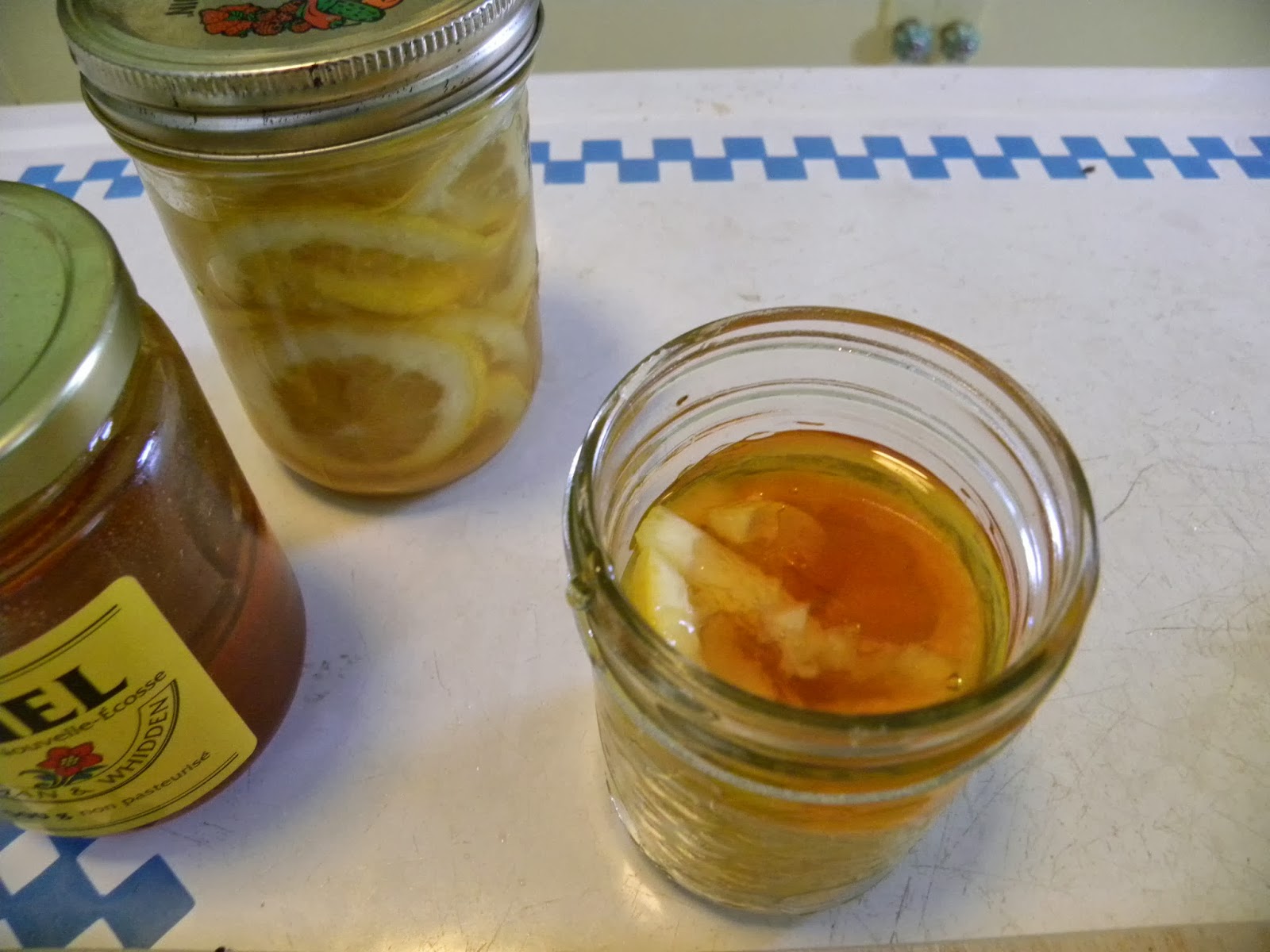
I found this lemon soother recipe over on Local Kitchen (see side bar) who had found it on Twenty-Two Pleasant.

http://twentytwopleasant.blogspot.ca

It is not measurement specific.

 Slice two or three lemons (after washing skin) thinly. Don't fuss about seeds. 

Shove into one or two or three jars. 

Cover with honey. Let the honey sink. Shake. Cover with more honey. Repeat until lemons are fully covered with the honey/lemon juice combo. This might take a day, depending on how thick the honey is.

Ideally, let it sit for a week. Phoebe and Steve both came down with sore throats and colds. They dove into a jar the same day I made it. They brewed endless cups of lemon tea and loved it. Very soothing. They both added Rooibos tea to the lemon to make a heartier cuppa. Apparently, this lemon honey will do amazing things:
*keep in the fridge for weeks,
*can be added to by either slicing and adding more lemons, or adding more honey. An eternal jar kind of thing.
*co-join with your favourite alcholic beverage for an amazing toddy.
*do incredible soothing strokes to your ego for being home-made, synthetic free and wholesome.
*replaces throat lozengers if you make a tea, let it cool and take it with you to sip as you feel crummy during the day.

TA DAH !

Magic trick number two, Bread crumbs.

OK, for you old kitchen duffers, this should (!) be an old trick. But for the newbies, this is a real money saver. Bread crumbs? you say. How can a jar of bread crumbs save me money? The answer is because it replaces expensive pre-packaged options.

Shake and bake - never used it. Panko-smanko. Hamberger Helper - please. (what puncutation indicates scorn).

Here's how she goes:
Abra ca dabra too

Collect assorted bread ends. Different kinds of breads make for more interesting crumbs.

Then you put the stale bread crumbs in the grinder upper. This style is best, a blender can work but needs to be fed a handful at a time, or it will clog up.

 Pulverize the buggers.

Add to an airtight jar. That little gizmo can be bought in the canning section of Canadian Tire or maybe a grocery store. I love it. It gets used for any kind of jar work. Saves a ton of mess.

Close the lid, put on shelf where you will see it. Add it to ground meat to soak up juices, (meatloaf, meatballs) add spices and use as a topping to give crunch to mac and cheese, tuna casserole, baked pastas with grated Parmesan and so forth. Also makes a nummy coating for fish, chicken, porkchops and other meats I refuse to eat. How do I know it's nummy if I don't eat breadcrumb covered meat. My kids tell me so.

What if you don't have a grinder upper. There is a smaller, one or two cup version for sale that is worth considering buying. Over the course of the year, this appliance is pulled out over and over again and is a major piece in using the food we freeze and preserve.  If I had to give up an appliance to save on electricity, it wouldn't be this one. Or the washing machine.

No money? Then consider a rolling pin. Take a tea towel, a sheet of wax paper, bread crumbs, a sheet of was paper and a second tea towel. Roll away. You won't get a fine crumb but a nice 'rustic' crumb. It won't work for coating meat but the other ideas will still be fine.

Ta Dad Too

A final bread crumb tip. Take the torn bits of bread, get a large zip lock baggie, put bread bits in it, toss in freezer. Keep adding until baggie is full. You now have the makings for croutons or a great bread pudding, especially if you added some raisin bread or sweety breads (like ends of banana bread)

So, if you followed my advice about roasting red peppers and freezing celery, buying real Parmesan, you will have a good kitchen structure to take you through the winter. See you at the farmers market.

Monday, July 15, 2013

Urban Farming - July 2013

We've been working consciously on this project to turn our home into an urban farm for about three years now.

Before thinking this could work, we had already established organic garden beds, herbs, grapes, pollinating plants, open water for insects and birds. We used the clothesline, inside and out, installed a wood stove, use passive solar heat in winter, reduced water consumption and a few other odds and ends.

I had farm envy. I wanted horse manure to muck about, I wanted chickens to eat the bugs out of my veggie garden, I wanted to not have to listen to my neighbours playing loud, ridiculous radio stations. I discovered I was never going to get the small farm of my dreams and I had to readjust.

I moved along to frustration. How was I going to turn a determinedly north facing garden into a veggie patch? Chickens are outlawed in Halifax. Cows for sure weren't going to work. Miniature farm animals? No go. Everything I thought belonged on a farm, was roadblocked by being in the city.

Then I discovered two major things. One was the "100 mile diet" which I speak about  here. The other was the idea that homesteading is about switching my thinking from a consumer's to a producer's. Along the way, I realized there were many things we can do as homeowners that can make time on the earth a little less aggressive.

As you have read, we have switched our eating habits to eating nearly 100% locally produced foods. (Except there is a heat wave on and I am eating Mrs. Vickie's Chips and Sussex Gingerale, so I fib a little bit.) If it can't be locally grown, such as peanut butter, is there a local producer? If it can't be locally produced, such as coffee, can it be "Fair Trade"? If it can't meet any of these criteria, how important is it? So I do without bananas. I do without citrus fruit most of the year. I need an orange in January. It sparks me up to get through to March

As I look through the cupboards, I realize we really have shifted so much that it is hard to find anything that offends.

The Farming Goals haven't been so successful. Our garden is covered in shade. At best we get 5 hours of sun beside a maple that is so shallow rooted, nothing grows under it. It is a perfect place for overwintering the compost and storing a boat.

Livestock is impossible. Chickens, Ducks, Rabbits, Pigeons, Quail and Bees. All not allowed. I was feeling embarrassed at calling myself an Urban Farmer. How is that possible without a crop or an animal?

But good things began to happen. I realized that our garden is the only one in shouting distance with open water in the winter. The photo above is our small fountain. Usually the rocks are wet and there is easy access for small birds and insects. The photo below is our bird bath with electric warming feature.

We are the gathering spot for many bird species all year long. We've had odd visitors like the yellow breasted Flicker and the Rose Breasted Grossbeak. There are 5 different types of butterflies, 7 different types of wasps, several types of bees, and once, I saw rabbit foot prints. I know there are tons of mice. Any self respecting farm has mice.

I still felt embarrassed to mention my notions about Urban Farming. I came across this book again,

http://www.rootsimple.com/2010/06/the-urban-homestead/

The Urban Homestead by Kelly Coyne and Erik Knutzen. They have a great blog coming out of California that I enjoy weekly.

http://www.rootsimple.com/

I read this about 6 years ago, when

dreams of owning a real farm fell flat. I read it again 3 years ago, and put some more suggestions into action. I read it again this spring and realized that while I might not be doing the usual routine of producing my own food and flesh, I am providing a highly essential ecosystem for pollinators. Those butterflies, bees and wasps are all needed to pollinate other people's vegetable gardens. These insects travel for long distances, getting their pollen fix.

Just recently, we became foster parents to a fledgling bee hive. I love them. They are fun to watch, they mind their own business beautifully and I am learning interesting things. They will stay here until they are strong enough to go to a permanent home. I might get a jar of honey out of it, if they do well. Come on Bees.

Monday, June 17, 2013

Local Poetry in Halifax

An espaliered fruit tree at Annapolis Royal Botanical Garden, Nova Scotia
Well, here's something new to me. I heard about this a year ago, but last week a hard copy of a poetry journal was placed in my hands and voila!

Open Heart Farming, The Second Seeding, Vol 2. is now available at
http://www.ohforgery.com/

Open Heart's mandate is simple, yet powerful. It is an annual journal of poems on food and farming by Nova Scotians. It is published by Open Heart Forgery, Halifax's grass roots poetry journal. Each month there is a free, downloadable collection and they ask you to share it with others.

Here we have a different kind of garden, local effort, local art, inspired by local greens or not, if there's a drought. It is modest, humble and perfectly beautiful.


There is an annual Anthology, available at Bookmark for $10 or you can order it online (I think)
http://ohforgery.com/OHFanthology.html

I'd like to share with you two poems, one by a Quaker Friend, Sylvia Mangalam and the other because I like it. Of course, I like Sylvia's as well, but there is the Quaker connection that is always fun to toss out.

Fall Rite by Sylvia Mangalam

The Kentucky Blue bean swelled
Bigger than they should.
Tired of the garden,
I picked them anyway.

It's a sort of rite
This anticlimatic harvest
Reaching for the high fat ones,
Rounded over full seeds.

Gathering up the dry corn--
What can I do with this?
The last green tomatoes,
Last marjoram sprigs--

This genuflecting gleaning
Respects all the work here
Of God, of worms, of me.

And this one by Jaywant (Joe) Patil

Fruitless Tree (inspired by Luke 13:6-9)
The farmer about to chop down the tree
which had been fruitless for year three.
Give me another chance begged the tree.
I will be fruitful for sure next year,
if you fertilize and dig around me this year.
Everyone deserves a second chance sire.

These two poems have a spiritual dimension, but there are lots of plain old secular poems as well. One dedicated to hops, another to alfalfa, another to saltwater.

Tuesday, November 6, 2012

Fall Offerings 2012

I didn't have a great summer for flowers but this little darling kept me amused. It is the foliage of the ornamental sweet potato plant. A lovely range of purples all summer long and it loves the shade.

Other fall offerings are now on the table. Steve had a Saturday of intense inspiration and he came up with....
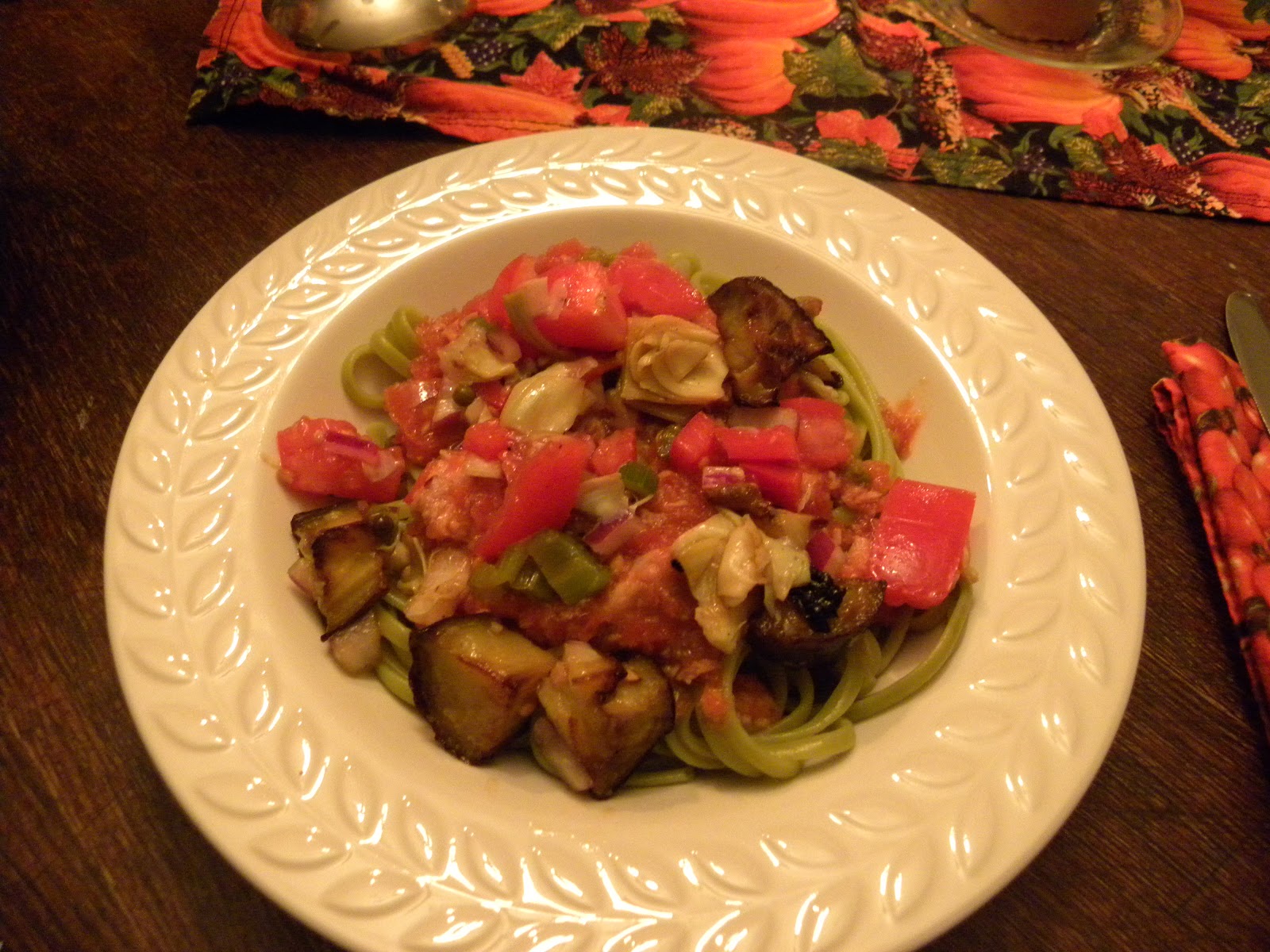
 Caponata salad from Sicily. It contains the last of the field tomatoes, local egg plants, red onions, artichokes from Italy. Steve did not deep fry the eggplant but roasted it. He fried the onions and garlic, tossed the whole lot together and marinaded it in our favourite olive oil, produced in Italy on a small family farm and sold in Halifax by the Canadian branch of the family.

 I love the combination of tomatoes and tuna. A few onions, garlic and capers and delight. For a slight variation, he added some black olives and red pepper. The sauce should look a very happy red, but the shadows are wrecking the true colours.

I put both dishes on my spinach linguine. Steve was more precise and had the salad on the side. God, it was delicious. I'm so glad there was enough for another meal later in the week!

Tuesday, September 18, 2012

Local Food and Winter Blahs


There are other colours for winter foods besides brown. If you are trying to go local or organic, this winter preparation will help to make your cooking more interesting. All it takes is about 2 hours on a weekend afternoon, 3 veggies and one box of snack sized zip lock baggies, one cookie sheet, a broiler or a bbq. If you want to go extreme, add in one fruit and one very large zip lock baggy.

Here's how:
Clean out your freezer of junk and knock off the ice build up.
Buy 1 box of snack sized baggies. Find one or two large sized baggy or 3 of the plastic bags that veggies go into at the grocery store.

Buy (from the Farmer's Market at Seaport on Saturdays, or the Farmer's Market at the VG Hospital on Fridays):

one bunch of celery
10 red peppers or a selection of different coloured peppers, not green (because green makes you burp).
10 small eggplants
4 pints of blueberries

Wash all of the above and do the following:
Celery - make sure there isn't any dirt in the lower regions or the leaves. Cut the root off. Cut the entire plant up into 3-4 inch bits. Yes, the leaves also. Toss it around a bit so there is an even distribution of leaves and stems. Stuff into baggies, squeeze out air, place on a cookie sheet or a shallow cardboard box. Wait.

Red peppers - core out the seeds. Cutting into strips is optional. Toss with olive oil or any other cooking oil, but sesame oil might be weird. Roast on a BBQ or under a broiler until pepper has lost its shape. This usually means the skin will burn. Allow to cool. Using a rounded spoon, scrape off the burnt skin. Stuff into baggies, remove excess air and place onto cookie sheet and Wait.

Eggplants - cut into quarters. Toss with olive oil or another oil. Sesame oil might be interesting for these. Roast on the BBQ or under a broiler with the red peppers. They are done when they are completely soft. They may take a bit longer than the peppers. Using a sharp knife, peel off the burnt skin, if you don't like it, otherwise, leave it on. Once cool, stuff into baggies, remove excess air and move onto step 2.

Blueberries - wash all the blueberries, remove any stems or bugs, place onto a large tea towel and sort of gather up the tea towel into a bowl shape. Shake the bowl shaped towel so the berries dry. Place all the berries into the large baggy or the several thinner bags. Place at the front of your freezer so you see it every time you open the door.

Step 2 for veggies:
All the baggies except the blueberries have been place on the same cookie sheet, No? If not, then do so. Place the cookie sheet in a level position in the freezer. Let freeze for 10 hours.

Step 3 for veggies:
If you are an organized person, remove the frozen baggies from the cookie sheet, return cookie sheet to its home. Place the 3 frozen veggies into the door of the freezer. Make a sign to remind you they are in the freezer. If not, just make the sign and tell someone where the cookie sheet is this winter.

How to use your fruit and veggies when the winter is looking pretty bleak for local food stuffs.

Celery - use in making homemade soups, chop into chili or spaghetti or bean soups, add to casseroles, and you have a few spots of green in another wise dull looking dish.

Red Peppers - add to anything that is looking forlorn. Add to pizzas, foccaio, hummus, bean soup or salad, eggs, chicken sauces, fish sauces. Whatever, it adds a nice red to everything.

Eggplants - really, these are brown, but they are a good protein source and can be added as is, or pureed to pizzas, eggs, pasta sauces, into meatloaf. They just extend the flavours of winter a little bit. Some people think they are tasteless, but I think they add a dark, roasted flavour to food.


Blueberries - chip off a 1/4 to 1/2 cup at a time and add them to muffins, plain cakes, coffee cakes, oatmeal cookies, oatmeal, pancakes, french toast, yogurt, applesauce, smoothies, drinks, martinis, and you have a nice blue juice. No long distance fruit for you!

Friday, September 7, 2012

Finally, beloved September!

I just love September, always have. It's back to school time for Steve and the kids, even though they are way past the usual going to school age.Yesterday was the first day of lectures, so Steve did his nearly famous introductory class to Sustainability 1000, Phoebe picked up her keys for the office that Teaching Assistants use at King's College and Lucas headed back to his study carol to get back to work on his thesis. It was also Lucas' birthday, we had a nice birthday breakfast for him.


Here's the newest member of the family, Snow. He's Lucas' cat and does he add a lot of excitement to the place! Mostly nice. We don't have carpets, so he's finding the lack of traction difficult.

I am not back into the rhythm yet. Too many outstanding issues from the summer, but the gap is closing. Just by writing this blog entry, I am nearly back to my desired schedule. I have been working on my online embroidery course all August. Mostly it's about making samples that can be worked into my future textile pieces.  The one above is a machine made fake organza ribbon that I have embroidered and later added to a different piece. The ribbon is about 4 inches long.

This is my current favourite, even though it is a beginner effort. I like the peek-a-boo-ness of the textile coming up from behind. I have plans for this lesson.

I also liked the techniques I learned on this sample. There is cutwork (the big open hole) and stitching on mirrors and adding lace or textiles behind holes
.

I worked it up a bit more and ended up with this as my sample.

I confess that I am a little confused as to what to do with this blog these days. My initial intention was to write about urban sustainability issues and tag on a few bits of studio work when they were relevant. These days, the blog is more about the studio and less about urban issues.

We are still heavy practitioners of  attempting to live simply and sustainably. The folks I interact with on a daily basis give me good feed back on the studio work. There is a pounding silence on other matters. Since I don't really know who is reading and for what reasons, I wonder what I should continue to write about?

For the time being, I will chat a bit about our dehydrator. Last summer, we dried about everything we could put our hands on. Not everything was a success. I did not like the apples with the peelings still on, nor did I like the strawberries, but Steve did. The bananas were a dismal failure. Too bad because I really liked the idea of banana chips. The blueberries were the best so we repeated that just last week.


We watched a Blue Jays Game, luckily a slow one, while we stabbed about 8 cups of wild blueberries before putting them in the dehydrator. It gave us 5 x 1cup baggies of dried blueberries, to be used in scones, muffins, and trail mix.


Cleo Belle decided to help, by keeping Steve's legs super warm, while the dehydrator was heating up the kitchen when the temperature was nearly 80. We are going to do the apples and pears again this summer, but this time peel the apples. The dried pears were very nice in trail mix, which was sucked down every time it was tucked into lunches. It was especially popular when the lunches were made for a day of sailing.

This summer's drying experiment is going to be mushrooms. I'm not sure if there is a local producer of mushrooms, we'll scout around the market this Saturday. But even if we can only get Canadian mushrooms, and dry those, it will be better than those from Brazil or Australia this winter. Less oil.

Regrettably, the list of things to do left over from the summer includes some finances, cleaning the camping gear in the basement, sorting out the boxes in the garage and attic from Lucas' move home and finding storage for it all.  Too bad the list doesn't have things like pedicure and lemonaide with friends on it this week.