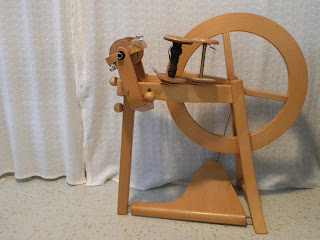
Here's the spinning wheel photo I promised. It's called “The Herring Spinning Wheel” and was produced by Frank Herring and Sons from Dorchester, Dorset, England. It is made using a bent wood construction process. The design is elegant and the curves are known as “sweet” in the boat building world. It is very Scandinavian in it's aesthetic and so Mod! It's only failing is that it does not compact down for travel but I can live with that. I came by it in a rather extraordinary way.
The local spinning group used to meet at a lady's home down the road. She has an enormous living room and we could fit about 10 ladies in there, each with their spinning wheel and coffee mug. Spinning of wheels and tongues would ensue. It was great fun but eventually, too many people cottoned on, we outgrew the space and things have since moved to Scott Manor House in Bedford, one Saturday a month. Check out ASH if you want to know more at http://www.parl.ns.ca/ash
About a year ago, I was sitting there trying to spin on my drop spindle (which I forgot to photograph) with little success. I wasn't really joining this group for spinning reasons, more because each of them is also a weaver and the only way I could connect with very smart weavers was to come to this event and spin. The drop spindle was a prop. A fake. I could care less. I was using batting that had felted up and wouldn't yield easily to being spun. I just jollied along, hoping no one would notice and kept asking my weaving questions. One day, a new comer from Scotland was sitting opposite me and she observed my failing efforts. In a leap of kindness, she handed over about 3 metres of lovely merino batt and showed me how to do things properly. And because I didn't want to be caught in my deception, I did what she said. A few weeks later, in she trots with this lovely little spinning wheel and announces to the group, “This wheel is free to a spinner who doesn't have a spinning wheel. I hope everyone is honest and doesn't take it if you already have one. I received it from an elderly lady in Scotland, free to me on the condition that I pass it along to someone who is wheel-less”. All heads turned my way. “That would be me” I said and found myself the owner of this lovely wheel.

Not only was I impressed with this generous act, I was impressed with the idea that the wheel was making an impact in the realm of passing on a craft. A nearly non-conditional gift meant that I could stop faking it and really get to know the roots of my craft, weaving and textile arts. I could learn where the initial resource, the fleece, came from, how it was processed and eventually how it lands in my lap in the form of knitting yarn (sweaters), or weaving yarn (cloth), or embroidery yarn (ornament).
I had only two things to do, learn how to spin, and pass it on. Since that day I have managed the first and plan on the second. I had to laugh in that Steve, who seems unable to fail at anything besides the game “Memory”

was able to make the spinning wheel work before I could.
You have seen the first grey/taupe fleece that I have spun and I am now working on the oatmeal-y fleece from the next sheep. Over Christmas I found a small bit of batt from a friend's stash that ended up in mine when she purged her collection. That was great fun to work on because it was already dyed and resulted in a multi-coloured yarn.

I figured the approximate time it takes to get this fleece from sheep back to human back. The sheering – 10 minutes (recovery time for sheep unknown), washing of fleece in basement – 3 hours (this included while waiting for the different steps to conclude: dusting the basement after the radiator covers were sanded for staining, putting away the summer camping equipment, and dusting off the jars in the root cellar (? I know)), carding the fleece – 5 hours over the course of several days to avoid shoulder injury. Unfortunately one can't multi-task during carding because the carder makes a racket and it is impossible to listen to an improving audio book, or any kind of audio at all, including the ringing of the phone. I am not sure how long the spinning will take, probably about 10 hours over the winter. The knitting should take about 2 years given my usual attention span and this includes knitting a portion of the sweater twice because I always end up ripping something back to the beginning. All in, the sweater takes about 30 hours and 15 minutes.
I find this astonishing. 30 hours per large garment ! Women did this sort of work endlessly before the Industrial Era began and to think that some women did this to earn extra or primary income for their families! They did this while (maybe not while, that could be dangerous but you get the idea) cooking on wood or coal fired cooking devices, washing clothes by hand, emptying chamber pots and let's not mention the mayhem caused by various stages of reproductive events. Just imagine if you had to clothe your own family of 3.5 people by hand, knitting only. You wouldn't have to sew any garments, or household linens, just concentrate on knitted items.

Go through your own closet, sock and stockings drawer, the mitten basket at the front door, your kids clothes made now of plastic (which would have been wool items before) and think about how many hand hours those would have taken. Is it any wonder closets were smaller in the old days? No one could afford the time it would take to knit all that. Is it any wonder a kid would freak out if a mitten went missing? Mom would have something stern to say about that.

On the one hand I am grateful to the Industrial Age so that I don't have to do this endlessly. I am also grateful that wool is processed by someone else, otherwise all the socks and mitts and Christmas gifts would never materialize. On the other hand, I am somewhat saddened that many of us don't appreciate the incredible dedication hand made items do take and how we treat them so indifferently in our culture. As usual, a balance needs to be struck between the romanticizing of the past (I'm prone to it), blindly thinking a sustainable future means a return to hand made items and recognizing that certain industrial practices, with clever interventions, can become less careless of the environment and the workers within an industry. The balance will ultimately come when we recognize that to do things in a thoughtful, harmfree way, we will no longer be able to pay $12.00 for a men's large sweater at a discount store, nor will we be able to afford to pay what it really costs to make a garment and treat it like a kleenex.

All this from the sweetest little spinning wheel I ever saw.


